No products in the cart.: $0.00

Moonstone Meaning: Properties, Benefits & How to Wear It
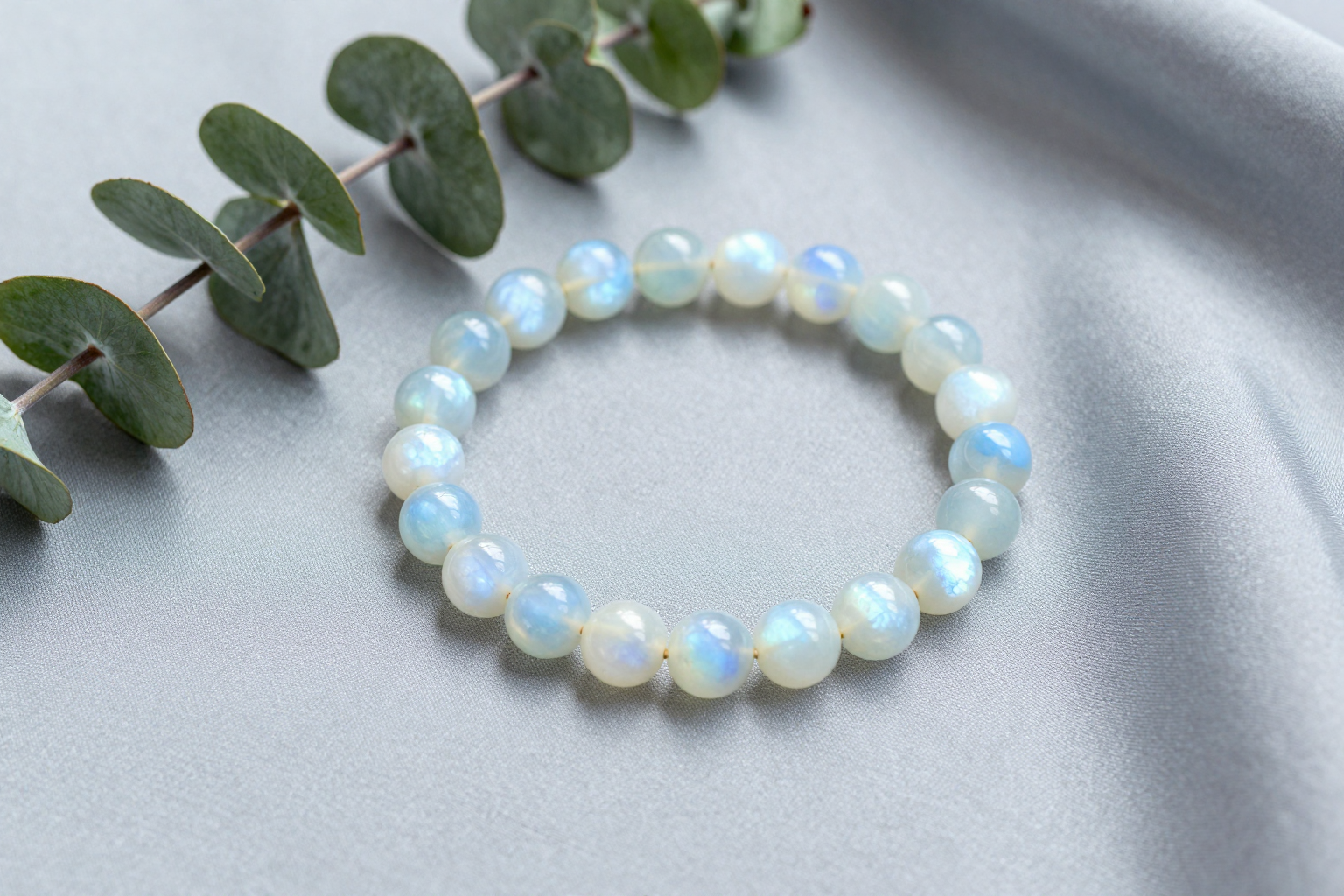
Moonstone is a variety of feldspar that glows with a soft, billowy sheen known as adularescence — a band of light that seems to float beneath the surface when the stone moves. Across crystal traditions it is valued as a stone of intuition, emotional balance and new beginnings, which is why it is often called “the stone of the moon” and recommended for anyone navigating change, deepening self-trust, or seeking a calmer inner rhythm. Worn most commonly as a bracelet, it pairs everyday elegance with a meaning that has stayed remarkably consistent for over two thousand years.
Few gemstones carry a glow quite like moonstone. Unlike the hard sparkle of faceted gems, moonstone breathes light — a milky blue shimmer that rolls across the stone as your wrist turns. That singular effect, plus a long history in Roman and Indian jewelry, has made it one of the most loved and most asked-about bracelet stones in our store.
This guide covers what moonstone is, what it has meant across cultures, the benefits people associate with it today, and how to choose, wear and care for a moonstone bracelet.
Quick Answers About Moonstone
| Question | Short Answer |
|---|---|
| What is moonstone? | A translucent feldspar mineral showing adularescence — a floating sheen of light beneath the surface. |
| What does moonstone mean? | Intuition, emotional balance, new beginnings and connection to natural cycles. |
| Which zodiac signs suit it best? | Water signs — Cancer, Scorpio and Pisces — though anyone may wear it. |
| Which hand to wear it on? | Left hand is traditional, to “receive” calm and intuitive energy. |
| How do I clean it? | Lukewarm water, mild soap, a soft cloth. Never steam or ultrasonic cleaners. |
| How hard is it? | 6 to 6.5 on the Mohs scale — durable for daily wear, but it can chip on hard impact. |
What Is Moonstone, Exactly?
Moonstone belongs to the feldspar family, the most abundant mineral group in the Earth’s crust. Its glow comes from two interlocking feldspar types (orthoclase and albite) that split apart as the stone cools: light scatters between these ultra-thin layers and re-emerges as a soft, moving sheen. Gemologists call this adularescence, after an early mining locality near Mount Adular in Switzerland.
The Qualities That Define a Fine Moonstone
Not all moonstone glows equally. Three factors separate a memorable stone from an ordinary one:
- Sheen strength. The best stones show a sharp, eye-clean band of light that appears to float just below the surface, visible from multiple angles.
- Body color. Classic moonstone is colorless and translucent with a blue sheen. Gray, peach, green and chocolate varieties exist, as do rare rainbow moonstones (technically a related feldspar) with multi-color flash.
- Transparency and cut. For bracelets, beads are usually cut as smooth rounds or barrels to maximize the glow. Cabochons with a high dome concentrate light best.
Most commercial-quality moonstone today comes from India and Sri Lanka, with additional material from Madagascar, Myanmar and Tanzania. Indian stones often carry the warm peach-to-tan body colors; Sri Lankan material is famous for the vivid blue sheen collectors prize.
Moonstone Meaning Across Cultures
Moonstone’s reputation as a mystical stone is ancient and remarkably cross-cultural:
- Rome. Romans linked moonstone to Luna, their moon goddess, and believed the stone solidified moonlight. They wore it as an amulet for protection during travel and at night.
- India. In Hindu tradition, moonstone is associated with Chandra, the moon deity, and with the third eye. It was traditionally given as a gift to bring harmony between lovers — a custom that continues in parts of India today.
The common thread: moonstone is tied to the cycles of the moon — and therefore to rhythms, reflection and renewal. Early 20th-century Art Nouveau jewelers like René Lalique later made it a design-era icon.
Moonstone Benefits: What People Use It For
Crystal meanings are rooted in tradition rather than medical science — we share them as cultural and symbolic context. Here is what moonstone is most commonly chosen for:
1. Emotional Balance
Moonstone is the go-to stone for people who feel emotionally “full sail” — reactive, restless, or swept up by moods. Its association with lunar rhythm makes it a natural symbol for ebb and flow: feeling strongly without being controlled by the feeling. Many wearers describe it as a grounding presence during emotionally demanding weeks.
2. Intuition and Self-Trust
In crystal practice, moonstone is linked to the third eye and crown energy centers, and is traditionally used in meditation or kept nearby during journaling and reflection. If you are facing a decision and want to listen to your own judgment more than outside noise, moonstone is the stone most often recommended for that intention.
3. New Beginnings
Because the moon itself “restarts” every month, moonstone has become the classic gift for thresholds: a new job, a move, a recovery, a fresh chapter. It is one of the most gifted stones in our store for graduations and farewells — a small, wearable reminder that cycles close and begin again.
Moonstone and the Zodiac: Who Should Wear It?
Any sign can wear moonstone, but astrologically it resonates most with the water signs, who share its emotional depth:
- Cancer. Ruled by the Moon itself, Cancer is moonstone’s natural match. The stone mirrors Cancer’s caring nature while supporting the emotional boundaries this sign often needs.
- Scorpio. Deep-feeling and private, Scorpio benefits from moonstone’s gentle, reflective energy — a softer counterweight to the sign’s famous intensity.
- Pisces. The dreamer of the zodiac pairs naturally with a dreamlike stone. Moonstone supports Pisces’ imagination while helping filter emotional overwhelm.
In Chinese five-element thinking, moonstone’s translucent, flowing quality reads as a water-element stone — associated with wisdom, adaptability and quiet accumulation. Explore our water element crystal collection to see it in context.
Curious how moonstone compares with the other water-sign favorites? Our guide to crystals for fire signs makes a useful contrast — the stones that suit Aries, Leo and Sagittarius are almost moonstone’s opposites in character: bold, igniting, energizing.
How to Choose a Moonstone Bracelet
Look at the Glow, Not Just the Color
Under store lighting, every moonstone looks pretty. The test is the sheen: tilt the bead under a single light source. A good stone throws a visible band of light across at least part of the bead. If the glow is what drew you in, prioritize sheen over size.
Check the Body
Small internal “gardens” (fine inclusions) are normal in natural moonstone and part of its character. What matters is that beads are evenly translucent and free of large fractures.
Get the Size Right
Measure your wrist with a soft tape and add roughly 1.5 to 2 cm for a comfortable drape. Most adult women wear 15–16 cm; most men, 18–19 cm.
Match It With Your Other Bracelets
Moonstone is one of the most stack-friendly stones — its neutral sheen pairs with almost anything:
- Moonstone + amethyst for a calm-evening stack (intuition plus tranquility).
- Moonstone + clear quartz to brighten the look; quartz is traditionally used as an “amplifier” stone in crystal practice.
For a deeper symbolic piece, the Triple Harmony (San He) bracelet works beautifully alongside a single moonstone — one carries your Chinese zodiac harmony, the other your daily calm.
How to Wear Moonstone: Left Wrist, Right Intention
In the receiving-hand tradition, the left hand is the “receiving” side of the body, so a moonstone bracelet is most often worn on the left wrist — inviting calm and insight in. There is no wrong answer, but left is the classic choice for this stone. Good moments to wear it: meditation or journaling, emotionally heavy workdays, and any personal new beginning.
Worn daily, the beads develop a slightly warmer patina over the years — normal for feldspar, and part of the stone’s story on your wrist.
Caring for Moonstone
At 6–6.5 on the Mohs scale, moonstone sits in the middle of the hardness range: tough enough for daily bracelet wear, soft enough to need a little care.
- Cleaning. Lukewarm water, a drop of mild soap, and a soft cloth. Dry immediately. Avoid ultrasonic and steam cleaners — the internal layer structure that creates the glow can be damaged by vibration and heat.
- Storage. Keep it in a soft pouch; harder stones can scratch it if stored loose together. Avoid perfume directly on the beads, prolonged strong sunlight, and wearing it during gym sessions.
For optional energy-cleansing rituals, moonlight is the traditional method for this stone: leave it on a windowsill during a full moon, or rest it on dry sea salt overnight.
Frequently Asked Questions About Moonstone
Is moonstone a real gemstone?
Yes. Moonstone is a natural feldspar mineral. Gem-quality material is translucent with adularescence and has been used in fine jewelry for millennia — Art Nouveau pieces sell at auction today.
What is the difference between moonstone and rainbow moonstone?
Classic moonstone is orthoclase feldspar with a blue or white sheen. “Rainbow moonstone” is technically a transparent labradorite feldspar with a blue, multi-directional flash. Both are natural feldspars and both are beautiful; rainbow moonstone tends to show more colorful fire, while classic moonstone has the softer, more floating glow.
Can men wear moonstone?
Absolutely. Gray-to-tan varieties look especially good on men’s larger bead bracelets, and its meaning — steadiness under emotional pressure — is universal. The stone has no gender; only styles do.
Does moonstone fade or lose its glow?
The sheen is structural, created inside the stone, so it cannot wash out or wear off. However, prolonged years of strong direct sunlight can dull some body colors, and surface grime can mask the glow. Regular gentle cleaning restores the full effect.
Which signs should avoid moonstone?
In astrological tradition, no sign needs to avoid it. It is simply most resonant for water signs (Cancer, Scorpio, Pisces). If you want a stone matched to fire, earth or air energy instead, see our elemental guides — for example, amethyst suits air-sign Aquarius beautifully, and earth signs lean toward stones like jade and tiger’s eye.
How much should I expect to pay for a good moonstone bracelet?
Price depends on bead size, sheen strength and body clarity. Entry-level bracelets are affordable, while vivid blue-sheen, eye-clean beads command a premium. Rule of thumb: buy the best sheen your budget allows.
The Takeaway
Moonstone is that rare gem that looks like a feeling: quiet, luminous, unhurried. Whether you are drawn to its lore, its water-sign and five-element symbolism, or simply the way light moves under its surface, a moonstone bracelet is one of the most meaningful everyday pieces you can wear. Choose it for a new beginning, or gift it to someone starting one.
Ready to find yours? Browse the Cancer zodiac crystal collection — moonstone’s natural astrological home — or explore our full range of handcrafted crystal bracelets to pair it with.
 Please wait…