
No products in the cart.: $0.00

Labradorite Meaning: Properties, Benefits & How to Wear It
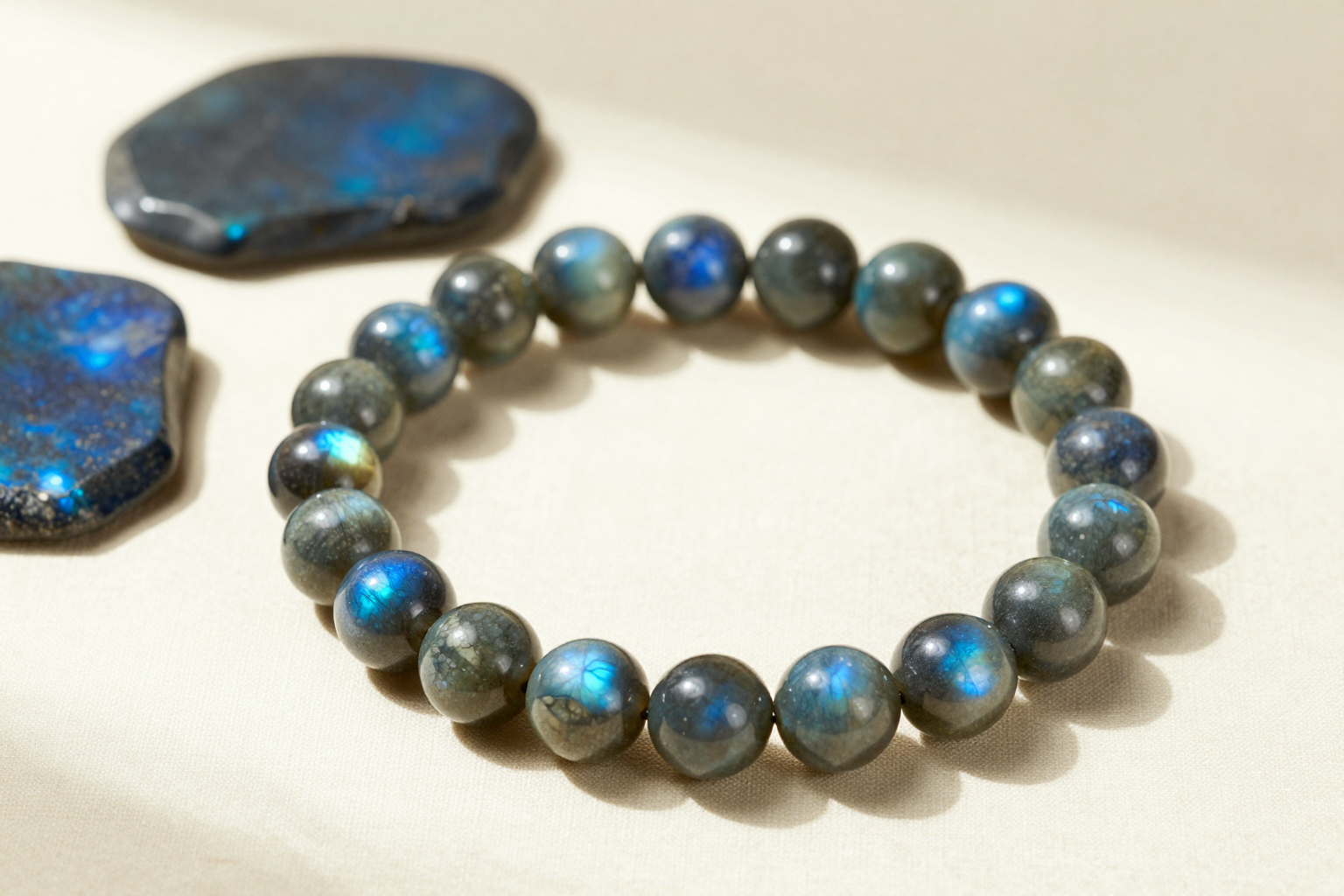
What Does Labradorite Mean in Crystal Healing?
Labradorite is the stone of transformation and quiet protection. Its flashing blue-grey surface is read as a shield for your energy and a mirror for your intuition. In crystal practice it is linked to the third eye and throat, carries a water-element nature, and is most often worn to steady you through change.
| Also known as | Spectrolite, rainbow labradorite, black moonstone (trade name) |
| Hardness (Mohs) | 6 – 6.5 (feldspar, with two directions of cleavage) |
| Chakra | Third eye and throat |
| Element | Water |
| Best for | Change, boundaries, intuition, willpower, creative nerve |
| Zodiac ties | Scorpio, Sagittarius, Leo, Taurus |
| Care | Wipe with a dry soft cloth; no steam, ultrasonic, or harsh chemicals |
What Is Labradorite, Exactly?
Labradorite is a plagioclase feldspar, a rock-forming mineral found wherever the earth has cooled slowly enough for its crystals to grow large. Most feldspar is unremarkable grey or white. Labradorite is the exception, and the reason is optical rather than chemical: thin internal layers, stacked in repeating sheets, split white light as it passes through. The result is labradorescence — a sudden blue, teal, green, or gold flare that appears and disappears as the stone moves.
The stone takes its name from the Labrador peninsula of eastern Canada, where Moravian missionaries recorded it in the 1770s. Finland’s Ylämaa region produces a rare, highly saturated variety sold as spectrolite, and Madagascar has become the main source of the well-behaved blue material used in jewelry today.
Labradorite Properties and Meanings
Transformation, on your own terms
Labradorite’s reputation begins with change. Crystal literature calls it a stone of transformation, and the imagery is unusually literal: a dull grey rock that reveals a hidden fire when you turn it toward the light. The intended lesson is not that change is comfortable, but that it is already there — your job is to angle yourself so you can see it and use it.
Wearers tend to reach for labradorite during chosen transitions — a new role, a move, a business outgrowing its old shape. On the wrist, it is a small daily prompt to keep moving while the ground is still shifting.
Protection for the energy-sensitive
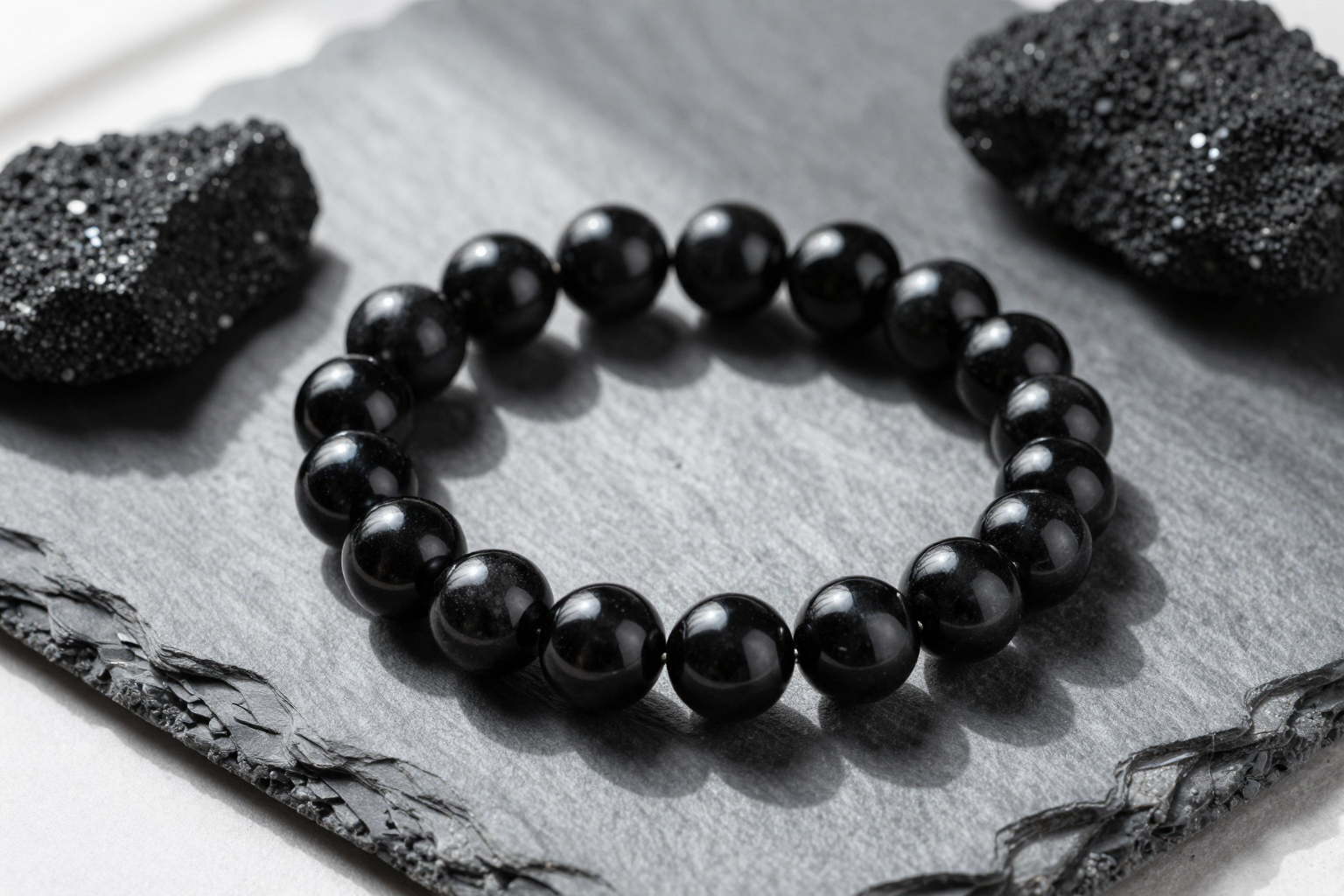
In crystal practice labradorite is one of the standard protective stones, close in purpose to black obsidian but gentler in tone. Where obsidian is described as a mirror that returns energy to its sender, labradorite is described as a filter — it is said to keep you from absorbing other people’s moods without shutting you off from them.
It is popular with people in close contact with others — therapists, teachers, nurses, sales teams — who end a day feeling oddly drained. The claim is not that the stone blocks feeling. It is that it gives you a boundary to stand behind.
Intuition and the third eye
Blue-flashing labradorite is tied to the third eye, the centre associated with insight, and to the throat, the centre of honest speech. The pairing is the point. Intuition is of limited use if you cannot act on it or explain it, and labradorite is traditionally worn to close that gap — to help you trust a hunch and then say it out loud. People wear it for decision-heavy weeks: reading a contract, judging a person, choosing between two paths that both look reasonable on paper.
Willpower and creative nerve
The gold and copper flashes, less common than blue, are associated with willpower and follow-through. This is the least mystical and most useful reading of the stone: labradorite is popular with makers, writers, and founders because it reminds them that inspiration is worthless without the unglamorous middle of the work.
Labradorite and the Zodiac
Labradorite is not a birthstone, so its zodiac ties are traditional associations rather than rules. Four signs come up most often.
| Sign | Element | Why labradorite |
| Scorpio | Water | Supports deep inner work and protects a naturally porous emotional boundary |
| Sagittarius | Fire | Matches the sign’s appetite for travel, philosophy, and reinvention |
| Leo | Fire | Turns visibility into something the sign can carry calmly |
| Taurus | Earth | Eases a fixed sign’s resistance when change is unavoidable |
Scorpio: water meeting water
Scorpio and labradorite share a water nature, which is why this is the most often cited pairing. Scorpio is described as intense, private, and prone to taking on the emotional weather of a room. Labradorite’s protective reading — filtering without numbing — fits that brief almost too neatly.
Sagittarius: the traveller’s stone
Sagittarius is the sign most associated with long journeys and changed minds, and labradorite’s transformation theme follows the same line. It is also the sign that most often gets told to slow down; the stone’s steadier, boundary-setting quality balances that without dampening the restlessness.
Leo and Taurus: two kinds of stubbornness
Leo’s challenge is performing rather than being seen, and labradorite’s throat association is said to help the sign speak from the self rather than the stage. Taurus resists change longer than any other sign; a transformation stone is less about pushing and more about permission.
If your sign is not on this list, that is not a disqualification. The wider water signs guide and our zodiac bracelet guide will help you match a stone to your chart instead of a list.
Labradorite and the Five Elements
In the Chinese five-element system labradorite is usually assigned to water — cool in tone, fluid in appearance, and associated with depth, rest, and the hidden. Water is the element of what moves under the surface, which is an accurate description of how labradorescence behaves.
This makes labradorite a natural companion for anyone building a water element bracelet, and a useful counterweight for charts that run hot. If you are working from a birth chart rather than a sun sign, our guide to triple harmony bracelets explains how a three-stone combination is balanced across elements — labradorite often sits in the water slot beside a fire stone and an earth stone.
How to Wear a Labradorite Bracelet
Left or right wrist?
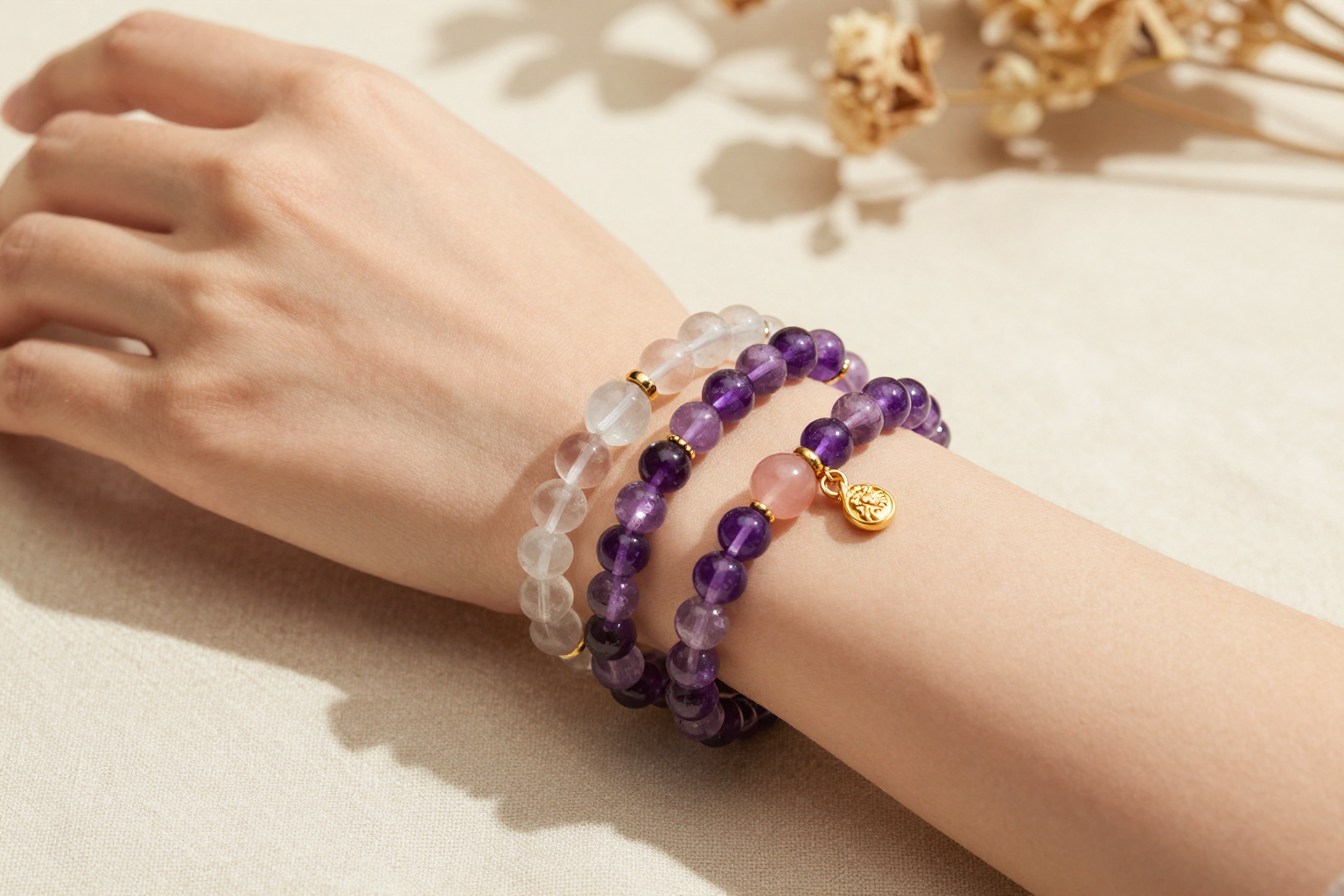
The common convention in crystal practice is receptive stones on the left, expressive stones on the right. Labradorite sits awkwardly between the two: protective by reputation, intuitive by chakra. Most wearers put it on the left for calm and boundary-keeping, and on the right when they want it to support speaking, deciding, or performing. Neither is wrong. Pick the one you will actually notice.
Stones that pair well
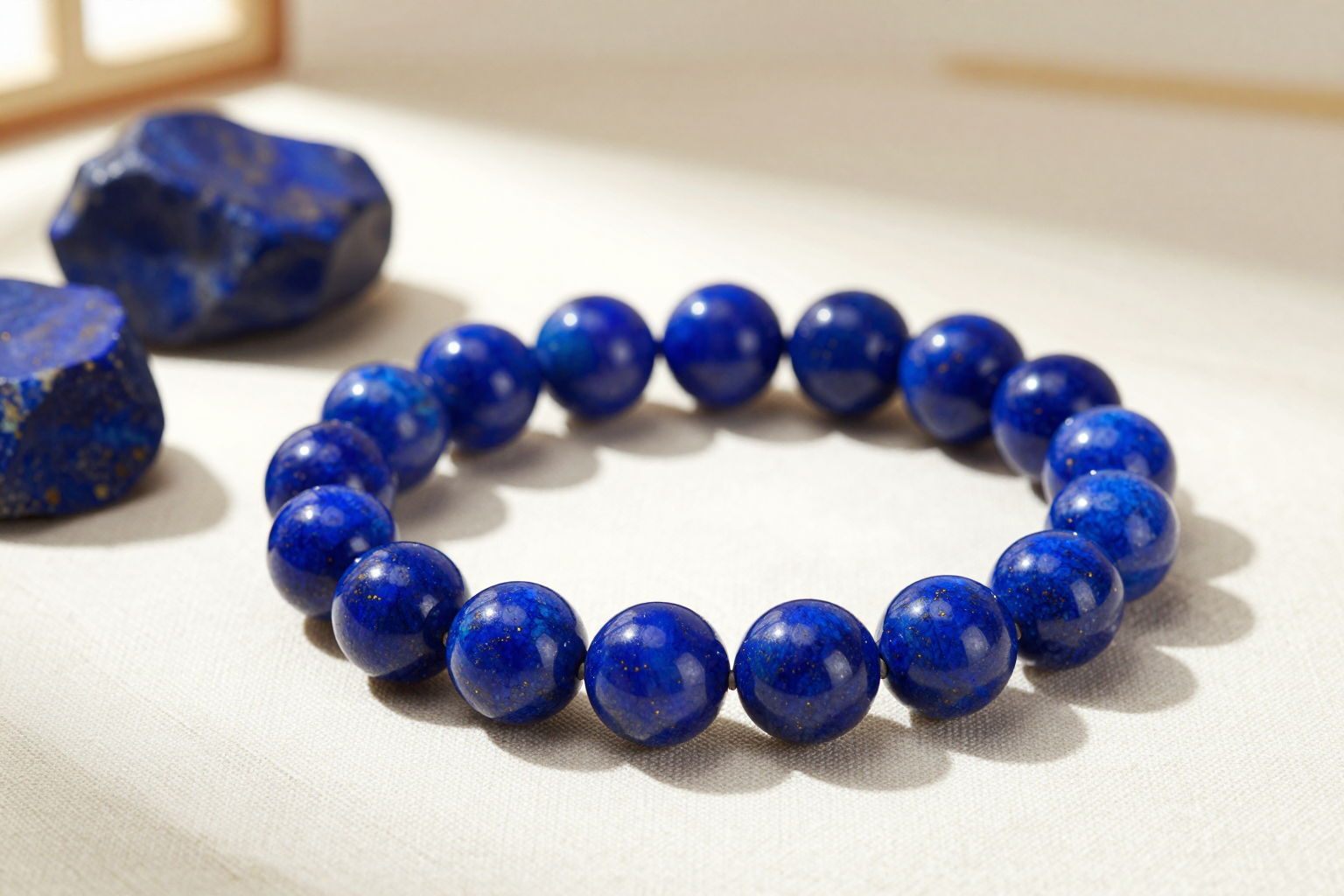
Labradorite is a cool, mid-tone stone, so it stacks easily. Moonstone deepens the intuitive theme, obsidian sharpens the protective one, and lapis lazuli reinforces the throat and third-eye link. For a warmer contrast, a single tiger’s eye or citrine bead breaks up the blue-grey without fighting it.
Fit and daily wear
Feldspar is tough enough for daily wear but not for carelessness. A bracelet that knocks against a desk edge will eventually chip a bead, so a snug fit — one finger’s width of slack — is kinder than a loose one.
How to Choose Real Labradorite
Almost all of the labradorite on the market is genuine; the problem is grade, not authenticity. Judge a bead by its flash, not its base colour.
- Flash should move. Tilt the stone under a lamp. Real labradorescence shifts and disappears as the angle changes. A printed or coated imitation stays bright from every direction.
- Blue is the benchmark. Even, saturated blue across a whole bead is the top grade. Purple and gold flashes are rarer and priced accordingly; green and grey-blue are common and perfectly wearable.
- Look for cracks. Feldspar cleaves in flat planes, so surface-reaching fractures are a real risk. A hairline that catches your fingernail is a weakness, not a feature.
- Beware the coating. Iridescent glass sold as “aurora” or “rainbow” labradorite is a coated synthetic. It is usually too uniform, too light, and too cheap.
Caring for Labradorite
Labradorite is softer than quartz and has directional cleavage, which sets the rules. Wipe it with a dry, soft cloth after wear. Warm water and mild soap are fine for a deeper clean, but dry the beads immediately and thoroughly — never leave the bracelet soaking. Skip ultrasonic and steam cleaners entirely; both can force moisture into existing fractures. Keep it away from perfume, hairspray, and household cleaners, and store it in its own soft pouch rather than loose in a jewelry box where it will be knocked by harder stones.
For sunlight, brief exposure is harmless, but do not leave a labradorite bracelet on a windowsill for weeks. As with most colored stones, the sensible habit is the same as for citrine: wear it, clean it, put it away.
Frequently Asked Questions
Is labradorite a good stone for beginners?
Yes. It is affordable, easy to find in good quality, and forgiving of daily wear as long as you avoid knocks and prolonged water. Its protective and intuitive themes are easy to work with — no complicated ritual required.
Can I wear labradorite every day?
Yes, with basic care. Feldspar at Mohs 6 to 6.5 handles normal life well; the real risks are impact, soaking, and harsh chemicals. Wipe it after wear and it will keep its flash for years.
Does labradorite lose its colour?
The flash does not fade with age, but it can look dull when the surface is scratched or coated with body oils and sunscreen. A wipe with a soft dry cloth usually restores it. If a bead has gone permanently flat, the cause is surface damage, not lost energy.
Is labradorite the same as moonstone?
They are both feldspar, but different varieties. Moonstone is orthoclase with a soft adularescent glow; labradorite is plagioclase with sharp, directional labradorescence. The pale stone sold as “rainbow moonstone” is usually white labradorite.
Which chakra does labradorite work with?
Most sources assign it to the third eye, with a secondary link to the throat. That pairing — insight plus expression — is why it is often worn during periods that demand both clear judgement and clear speech.
Can labradorite go in water?
Brief contact with water is fine; soaking is not. Feldspar’s cleavage planes can trap moisture and weaken the stone over time, so dry it fully after cleaning and never store it damp.
Where to Start
Labradorite earns its place in a collection because it does two things at once: it protects, and it pushes. Worn as a bracelet, that grey stone with the blue fire becomes a daily reminder that the most interesting parts of a situation are usually the ones you only see from a different angle.
If labradorite sounds like your stone, start with the Scorpio collection, explore water element designs, or build a triple harmony bracelet around it. Browse the full HoldFate collection, or read more stone-by-stone guides in our crystal library.

 Please wait…