No products in the cart.: $0.00

Fire Element Crystals: Best Stones, Meanings & How to Wear Them
Crystals for the Fire Element: A Quick Answer
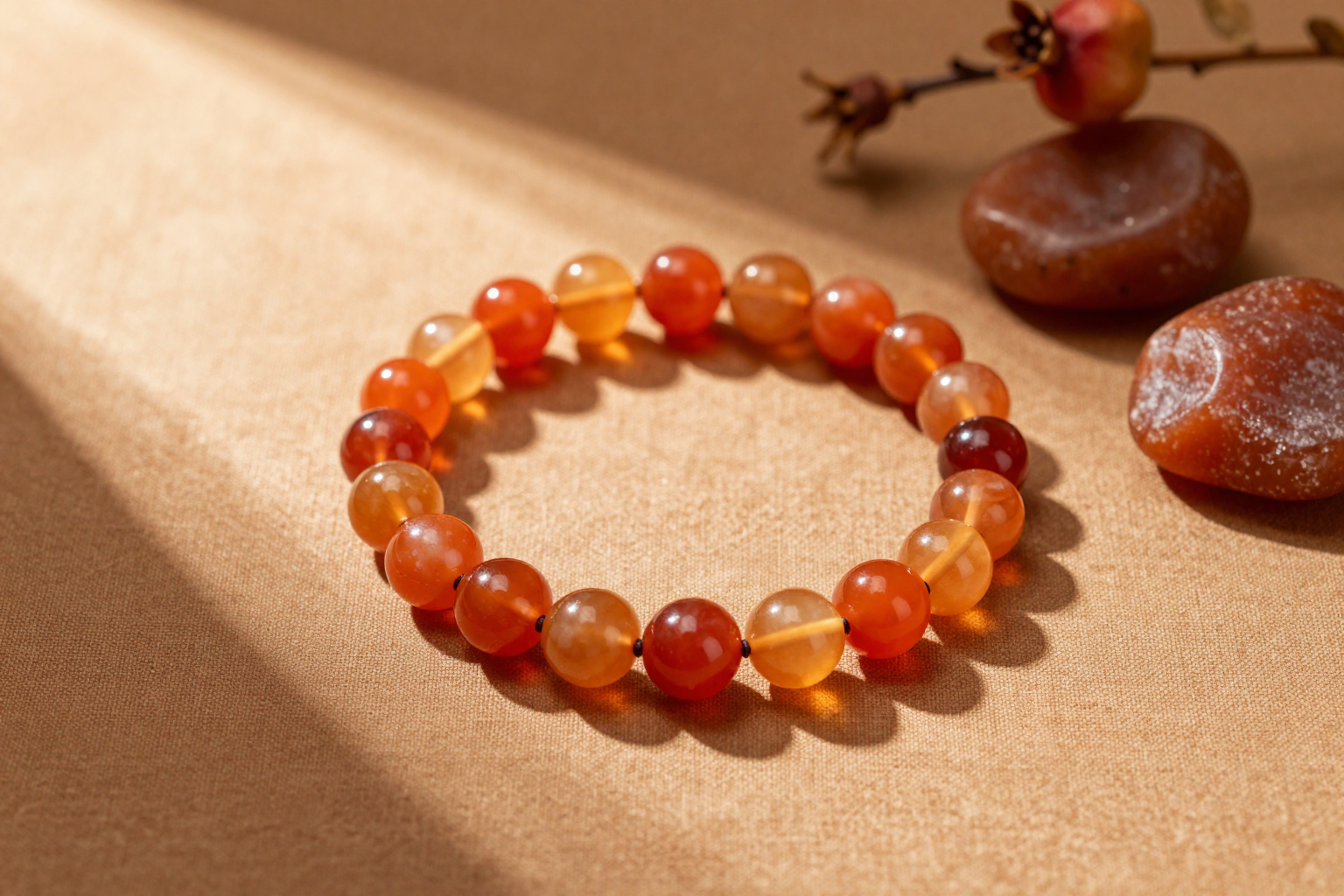
The fire element in Chinese five-element theory represents heat, visibility, passion, and the drive to be seen. Crystals traditionally paired with fire are warm-toned stones — carnelian, red jasper, citrine, tiger’s eye, and garnet — chosen for their color and their sun-and-heat association. A fire bracelet is usually built to support energy, confidence, and healthy recognition.
Fire at a Glance
| Attribute | Fire Element Detail |
|---|---|
| Sensory signature | Warmth, light, upward motion, quick contrast |
| Color family | Red, orange, amber, coral, warm gold, plum |
| Classic stone pairings | Carnelian, red jasper, citrine, garnet, tiger’s eye, rhodochrosite |
| Best used for | Confidence before a presentation, visibility in a new role, momentum on a stalled creative project |
| Traditional caution | Adds heat, so pair with earth or water stones if you already run hot or restless |
| Season of peak strength | Late spring into summer; also sunrise and midday hours |
| Complementary element | Wood feeds fire; earth tempers it |
| Controlling relationship | Water controls fire — useful as a balancing note, not a ban |
What the Fire Element Stands For
The five elements — wood, fire, earth, metal, and water — form a framework that predates crystal bracelets by millennia. In classical Chinese thought, fire is not simply flame. It is the principle of expansion and illumination: the force that turns heat into visible brightness, that makes one thing rise above another, that gives a person presence in a room.
In traditional practice, fire governs the heart and small intestine, the emotion of joy (and its shadow, anxiety), the southern direction, and the midday hours. Fire types tend to move quickly, speak plainly, and enjoy being recognized. When fire is balanced, the result is charisma and generosity; when excessive, impatience and burnout; when thin, feeling invisible or flat. If you want the wider framework first, our guide to the five elements and their generating and controlling cycles is the right starting point.
One useful thing to know before choosing stones: elements are not personality labels assigned at birth the way sun signs are. You can have a fire-dominant chart, a fire deficiency, or simply be in a phase of life that calls for more fire. An element-based bracelet is a support, not a diagnosis. If the idea of an imbalance speaks to you, our article on restoring balance when an element is deficient walks through the practical side.
Fire also has a natural place in the western zodiac: Aries, Leo, and Sagittarius are the three fire signs, and they pair naturally with the same warm palette. Our guide to crystals for Aries, Leo, and Sagittarius goes sign by sign, and the zodiac crystals chart shows every pairing in one place.
Why Warm-Toned Stones Belong to Fire
Traditional element mapping is largely a color-and-behavior system. The stones grouped under fire share a family resemblance: they are warm to the eye, they hold light rather than scatter it, and many of them come from iron-rich geology. Iron oxidizes into rust, rust is red, and red is the color of blood and flame — which is why iron-bearing red stones were grouped with fire long before anyone could test their chemistry.
Three properties matter when you are choosing:
Color
Saturated orange and true red are the strongest fire signatures. Amber, reddish-brown, and glowing plum are secondary. A very pale peach stone reads as fire only weakly, which is why peach rose quartz or pale pink tourmaline is usually classified under other elements.
Light behavior
A stone that looks lit from inside — carnelian with its translucent glow, citrine with its sunny clarity, fire agate with its shifting iridescence — carries the fire impression more convincingly than an opaque, matte stone of the same hue.
Heat origin
Some fire stones are heat-formed in a literal sense. Citrine is amethyst that has been heat-treated; carnelian is chalcedony that has been warmed to bring out its red. The traditional reading treats that formed-by-heat quality as a match rather than a flaw. We cover the honest version of that discussion in our citrine meaning and care guide.
The Fire Crystal Lineup
Six stones appear again and again in fire-element bracelets. Each one plays a slightly different role, so it helps to know what you are actually asking for.
Carnelian
The default fire stone. Warm orange, lightly translucent, and widely available, carnelian is traditionally associated with courage and with getting started — the first step, the first sentence, the first sales call. Its warmth is steady rather than sharp, which makes it a forgiving choice if you are new to crystal bracelets.
Red Jasper
Deeper, earthier, and more grounded than carnelian. Red jasper sits at the boundary between fire and earth, and many practitioners describe it as fire with a floor under it — drive that does not tip into restlessness. It is a strong pick for people who like the idea of fire energy but know they burn too hot.
Citrine
Sun-yellow rather than red, citrine is fire expressed as clarity and optimism. It is the stone most often paired with abundance and visibility at work. Because true natural citrine is rare and most commercial citrine is heat-treated amethyst, the traditional reading emphasizes clear intention over provenance.
Garnet
Deep red with a jewel-like finish, garnet is the most formal of the fire stones. It reads as focus and endurance rather than the bright spark of carnelian — a good choice for long projects and for anyone who wants fire that lasts through winter.
Tiger’s Eye
Banded gold and brown with a shifting sheen, tiger’s eye straddles fire and earth in most elemental charts. It brings a decisive, protective quality often described as the stone for making a call and living with it. Our tiger’s eye guide covers its properties and sizing in more detail.
Rhodochrosite and Fire Agate
Two specialist options. Rhodochrosite’s banded pinks and rusts are warm and emotionally open, sometimes classed as fire, sometimes as earth. Fire agate’s iridescent orange-green pairs beautifully with carnelian in a two-stone bracelet, though it is softer and needs more care.
How to choose between them
Start with carnelian if you want the plainest fire stone. Choose red jasper or tiger’s eye if you run hot and want warmth with a floor under it. Pick citrine for work visibility, garnet for long-haul projects, and the specialist stones once the basics feel tired.
Matching Fire Crystals to Your Chart
If you know your dominant element or your zodiac sign, the choices narrow quickly. The table below is the version most practitioners would give you over tea.
| Your Situation | Fire Stones to Start With | Why |
|---|---|---|
| Fire is your dominant element | Red jasper, tiger’s eye, a gold accent bead | Tempered warmth; keeps momentum without overheating |
| Fire is your deficient element | Carnelian, citrine, garnet | Direct boost of warmth, visibility, and drive |
| You are an Aries, Leo, or Sagittarius | Carnelian, citrine, tiger’s eye | Western fire signs map intuitively onto the same palette |
| Wood is dominant | One carnelian bead beside green stones | Wood feeds fire, so a touch of fire completes the cycle |
| Water is dominant | Carnelian with a small hematite or obsidian bead | Adds warmth while acknowledging water’s natural cooling |
| You work in a visible role | Citrine, carnelian | Associated with recognition and clear speech |
Fire, Visibility, and the Quiet Pleasure of Ritual
The most useful thing a fire bracelet does is mark a transition. Putting it on before a difficult meeting, or taking it off when the workday ends, gives the nervous system a small, physical signal. That ritual quality is ordinary psychology, and it is why people have worn elemental jewelry for thousands of years. If the five-element framework appeals to you, the broader reading of the bagua as a symbol system and the companion piece on yin and yang give fire its proper context: a bright, active principle that only means something in relation to its opposite.
Frequently Asked Questions
What is the best crystal for the fire element?
Carnelian is the most widely used fire stone, followed by red jasper and citrine. If you want one stone only, carnelian is the safest choice because it is warm enough to read as fire and stable enough for daily wear.
Can I wear fire crystals if I am water-dominant?
Yes. A single carnelian or garnet bracelet adds warmth and visibility without overwhelming a water chart. If you are strongly water-dominant, pair it with one dark grounding bead rather than a full fire stack.
Do fire crystals need to be cleansed differently?
Not much differently, but sunlight is the traditional method for fire stones and most of them tolerate it. The exception is citrine, which can fade in prolonged direct sun. Avoid salt water, which dulls polish and weakens elastic cord.
How many beads should a fire bracelet have?
Fit comes first. For most wrists, 8mm beads in a 17 to 19 bead bracelet work well. Traditional bead-count preferences vary by school, so choose the count that gives you a comfortable fit rather than a mystical number.
Is citrine a fire element stone or an earth element stone?
Both readings exist. Its sun-yellow color and heat treatment place it in fire in most Chinese five-element charts, while some practitioners group yellow stones under earth. If you are building a fire bracelet, citrine works as a bright, clarifying note; if you are building an earth one, choose a browner yellow stone instead.
Do fire stones go on the left or right wrist?
Many practitioners wear energizing stones on the left wrist and clearing stones on the right. This is convention rather than rule — comfort and your dominant hand matter more, and there is no harm in switching sides.
Where to Start
If you already know fire is your element, begin with a simple two-stone bracelet: carnelian for warmth and initiative, red jasper for the floor under it. If you are still working out your element, browse our full five-element collection or the fire element edit for ready-made options in warm tones.
And if you would rather let a sign pick the palette, start with the Capricorn collection for a grounding counterweight to fire, or Scorpio for a deeper red palette that still reads warm. For a first bracelet that carries more than one meaning, our triple harmony bracelet pairs three zodiac allies in one piece.
Whichever you choose, pick a stone you enjoy looking at. A bracelet you love gets worn, and a bracelet that gets worn is the only one that does anything at all.

 Please wait…