
No products in the cart.: $0.00

Crystal Bracelet Sizing Guide: How to Measure Your Wrist and Get the Right Fit
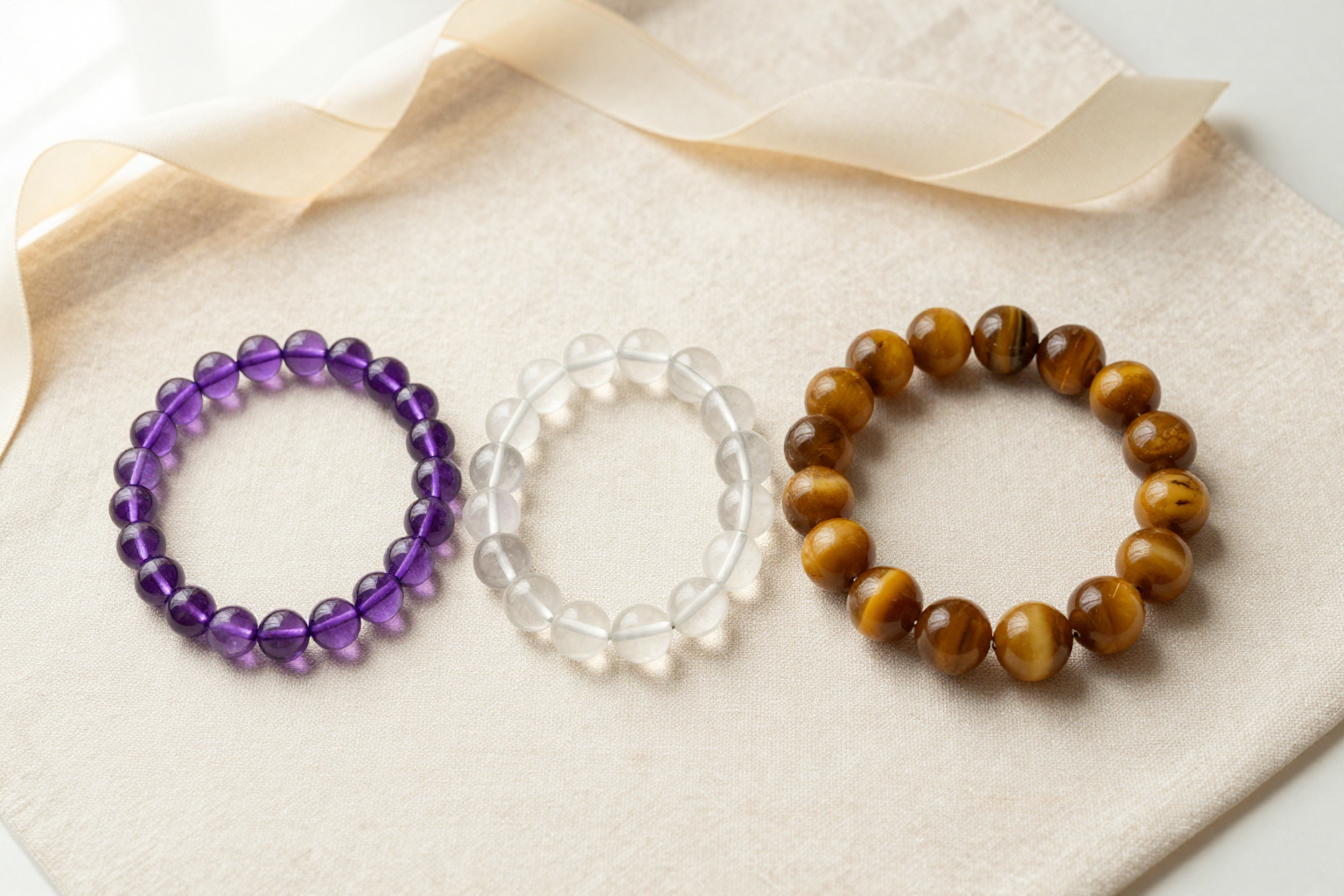
Quick answer: A well-fitting crystal bracelet should slide over your hand with light resistance, then settle on your wrist so it moves about half an inch (1 cm) when you shake your hand. To find your size, wrap a soft tape snugly around your wrist, then add 0.25 to 0.75 inch (0.6 to 2 cm) depending on how close to the skin you like your jewelry to sit.
Getting the size right matters more with crystal bracelets than with most other jewelry. Beads are rigid, elastic cord only stretches so far: half an inch too small feels like a tourniquet, while too loose slides around, catches on desks, and wears out its string early. This guide covers measuring your wrist, converting that number into a bracelet length, and choosing a bead size that matches your wrist and your style.
Quick Answer: Wrist Size to Bracelet Size Chart
Measure the distance around your wrist (not over your hand), then use this chart. “Snug” means the beads sit close to the skin with almost no movement; “comfort” is the usual starting point; “loose” leaves a visible drape.
| Wrist circumference | Snug fit | Comfort fit | Loose fit |
|---|---|---|---|
| 5.5 in / 14 cm | 5.75 in / 14.6 cm | 6.0 in / 15.2 cm | 6.25–6.5 in |
| 6.0 in / 15.2 cm | 6.25 in / 15.9 cm | 6.5 in / 16.5 cm | 6.75–7.0 in |
| 6.5 in / 16.5 cm | 6.75 in / 17.1 cm | 7.0 in / 17.8 cm | 7.25–7.5 in |
| 7.0 in / 17.8 cm | 7.25 in / 18.4 cm | 7.5 in / 19.1 cm | 7.75–8.0 in |
| 7.5 in / 19.1 cm | 7.75 in / 19.7 cm | 8.0 in / 20.3 cm | 8.25–8.5 in |
| 8.0 in / 20.3 cm | 8.25 in / 21.0 cm | 8.5 in / 21.6 cm | 8.75–9.0 in |
If you fall between two rows, round up to the next comfortable size rather than down; it is far easier to live with a bracelet that is slightly generous than one that leaves a mark on your skin.
How to Measure Your Wrist Correctly
Method 1: A soft measuring tape
Wrap a tailor’s tape around your wrist just above the wrist bone, where a bracelet naturally settles. Keep it flat against the skin and snug, but do not pull it tight; if the tape digs in or leaves an indentation, you are measuring too small. Read the number where the tape overlaps, noting it in both inches and centimeters for comparing with any shop’s sizing chart.
Method 2: A strip of paper or string
No flexible tape? Cut a strip of paper about half an inch wide, or use a piece of string. Wrap it around your wrist the same way, mark where the end meets the rest, then lay it flat against a rigid ruler and read the length. Paper is slightly stiffer than string, which makes it easier to keep flat; string can twist and read a few millimeters short. Check the mark twice before cutting anything to length.
Method 3: Trace a bracelet you already own
If you own a beaded bracelet that already fits the way you like, lay it flat and measure the inner length of the bead circle, end to end, excluding the clasp. That inner measurement is your target bracelet size, and it is often more accurate than any formula, because it already bakes in your preference for how much the bracelet should move. This works best with stretch bracelets; a clasped bracelet laid flat includes hardware in its length.
Three small habits that improve accuracy
- Measure at the end of the day. Wrists swell slightly with heat, activity, and salt; an evening measurement is the safer baseline.
- Take the tape off your watch first. Measuring over a watch band or a sleeve adds phantom millimeters.
- Measure the wrist you will actually wear it on. Dominant wrists are often slightly larger, and the difference matters at this scale.
Choosing Your Fit: Snug, Comfort, or Loose
The chart above gives you three columns because “the right size” is partly a style decision:
- Snug (+0.25 in / 0.6 cm): The bracelet moves with your wrist and barely shifts. The classic fit for a single meaningful piece, and the safest choice for larger-bead bracelets that already have visual weight.
- Comfort (+0.5 in / 1.3 cm): The bracelet moves about half an inch along the wrist when you shake your hand. If you are buying your first crystal bracelet or ordering online, start here.
- Loose (+0.75 to 1 in / 2 to 2.5 cm): The bracelet drapes and swings. Some people love the relaxed look, especially for delicate stacks on the non-dominant wrist, but a loose bracelet catches on sleeves and keyboards, and the constant flexing shortens the life of the elastic.
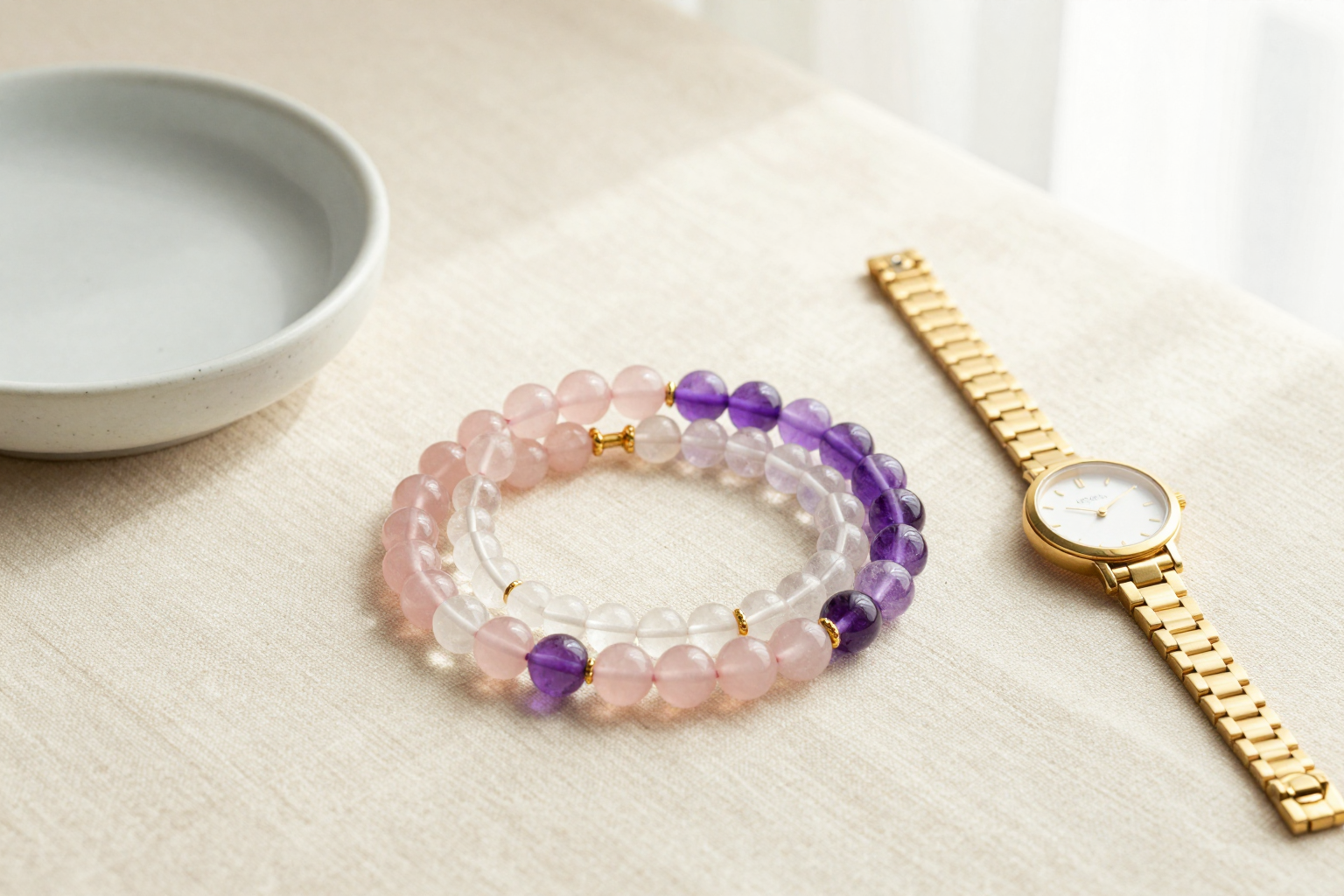
One more consideration: if you plan to wear your bracelet with a watch or other bracelets, size the pieces as a set. A snug bracelet next to a watch usually feels better than another comfort-fit piece crowding the same space.
Does Bead Size Change the Fit?
Yes, more than most people expect. Two bracelets with identical inner circumferences wear differently depending on bead diameter, because chunkier beads stand taller off the skin and present more bulk as your hand passes through.
| Bead size | How it wears | Best for |
|---|---|---|
| 6 mm | Delicate, sits low, stacks cleanly | Small wrists, minimalists, layering two or three strands |
| 8 mm | The all-rounder; visible color, comfortable weight | Most wrists and most styles; the default for a reason |
| 10 mm | Bold, substantial feel, reads clearly from a distance | Average to larger wrists, statement pieces |
| 12 mm and up | Very chunky, dramatic drape | Larger wrists, single statement strand |
A practical rule: once you move to 10 mm beads or larger, add roughly a quarter inch to the fit you would otherwise choose. A 10 mm comfort-fit bracelet on a 6.5 inch wrist is more enjoyable at 7.25 inches than at a strict 7.0. The larger the beads, the more the bracelet behaves like a rigid ring, and a little extra room keeps it from feeling restrictive when you bend your hand back.
Bead size also changes the look of a stack. Two 6 mm strands wear slimmer than one 8 mm strand, which is why many people build their first stack with a mix: one 8 mm strand carrying the main stone, flanked by 6 mm accents.
Stretch Cord vs. Clasp Bracelets: Sizing Differences
Stretch bracelets are the standard for crystal beads, and they are forgiving. Quality elastic cord stretches enough to pass over the hand, then recovers to its strung length on the wrist. For these, the comfort-fit column is the sweet spot. All elastic relaxes slightly over months of wear; rolling the bracelet on rather than pulling it wide preserves the fit much longer, as covered in our crystal bracelet care guide.
Clasp bracelets (with a toggle, lobster clasp, or extender chain) do not stretch, so they must pass over the hand during dressing. Size them for your wrist plus half an inch, and check that the smallest extender setting still clears your knuckles.
Rigid bangles are the least forgiving: the inside diameter has to clear the entire hand. To size one, tuck your thumb into your palm, wrap the tape around the widest point of the hand at the knuckles, and compare that number to the bangle’s inside circumference, not your wrist. Most crystal bangles are sold by inner diameter: a hand measuring about 7.5 inches needs roughly 2.6 inches or more.
Common Crystal Bracelet Sizing Mistakes to Avoid
- Measuring over the hand instead of around the wrist. The hand measurement only matters for rigid bangles.
- Pulling the tape tight. A taut tape reads a quarter inch small, which is exactly the difference between a comfortable bracelet and one that pinches.
- Ignoring the bead size when ordering. An 8 mm and a 10 mm bracelet of the same length do not feel the same; adjust as described above.
- Assuming every shop sizes the same way. Some brands list inner circumference, others total strung length including clasp. Read the product page’s sizing note before checking out.
- Buying small “just to be safe.” A chronically overstretched bracelet is the most common cause of snapped string; the fix is almost always sizing up.
Crystal Bracelet Sizing FAQ
How tight should a crystal bracelet be?
Tight enough that it does not spin freely, loose enough that you can slide one finger flat between the beads and your wrist. If it leaves an indentation after an hour, it is too small.
What is the average wrist size?
Most women’s wrists fall between 5.5 and 6.5 inches (14 to 16.5 cm), and most men’s between 6.5 and 7.5 inches (16.5 to 19 cm). A 7-inch bracelet is therefore the most common unisex starting size, but a real measurement beats any average.
Should I size up for larger beads?
Usually, yes. With 10 mm beads or larger, adding about a quarter inch to your normal fit prevents the chunkier strand from feeling restrictive. With 6 mm beads, no adjustment is needed.
How do I measure without a measuring tape?
Use a strip of paper or a piece of string, mark where it overlaps, and measure the mark against a rigid ruler. Avoid phone apps or eyeballing it; a few millimeters are the whole difference between sizes.
Do stretch crystal bracelets loosen over time?
They relax slightly within the first weeks of wear, then stabilize if treated well. Rolling the bracelet over the hand instead of stretching it wide, keeping it away from hot water and sunscreen, and storing it flat all preserve the fit; the full routine is in our care guide.
What if I am between two sizes?
Take the larger size, especially for 10 mm beads, for bangles, or if you plan to stack. A slightly generous bracelet wears as a looser drape; a slightly tight one just gets returned.
Find a Bracelet Worth Sizing For
Once you know your size, the fun part is choosing the stones. Browse the full collection of crystal bead bracelets and match a strand to your intention: pick your sign in the zodiac collection (the 10 mm strands in the Leo and Taurus edits wear beautifully at a comfort fit), work with an element in the five elements collection (the Water stones suit a snug 6 mm stack), or make the Triple Harmony bracelet your one meaningful strand.
If you are still choosing stones rather than sizes, our zodiac crystals chart maps all twelve signs to their best-matched stones, and our guide on how to tell if a crystal bracelet is real helps you check quality before you commit to a size. Measure once, note the number, and every bracelet you order after this one will fit the way it should.

 Please wait…
