
No products in the cart.: $0.00

Which Wrist Should You Wear a Crystal Bracelet? Left vs Right Explained
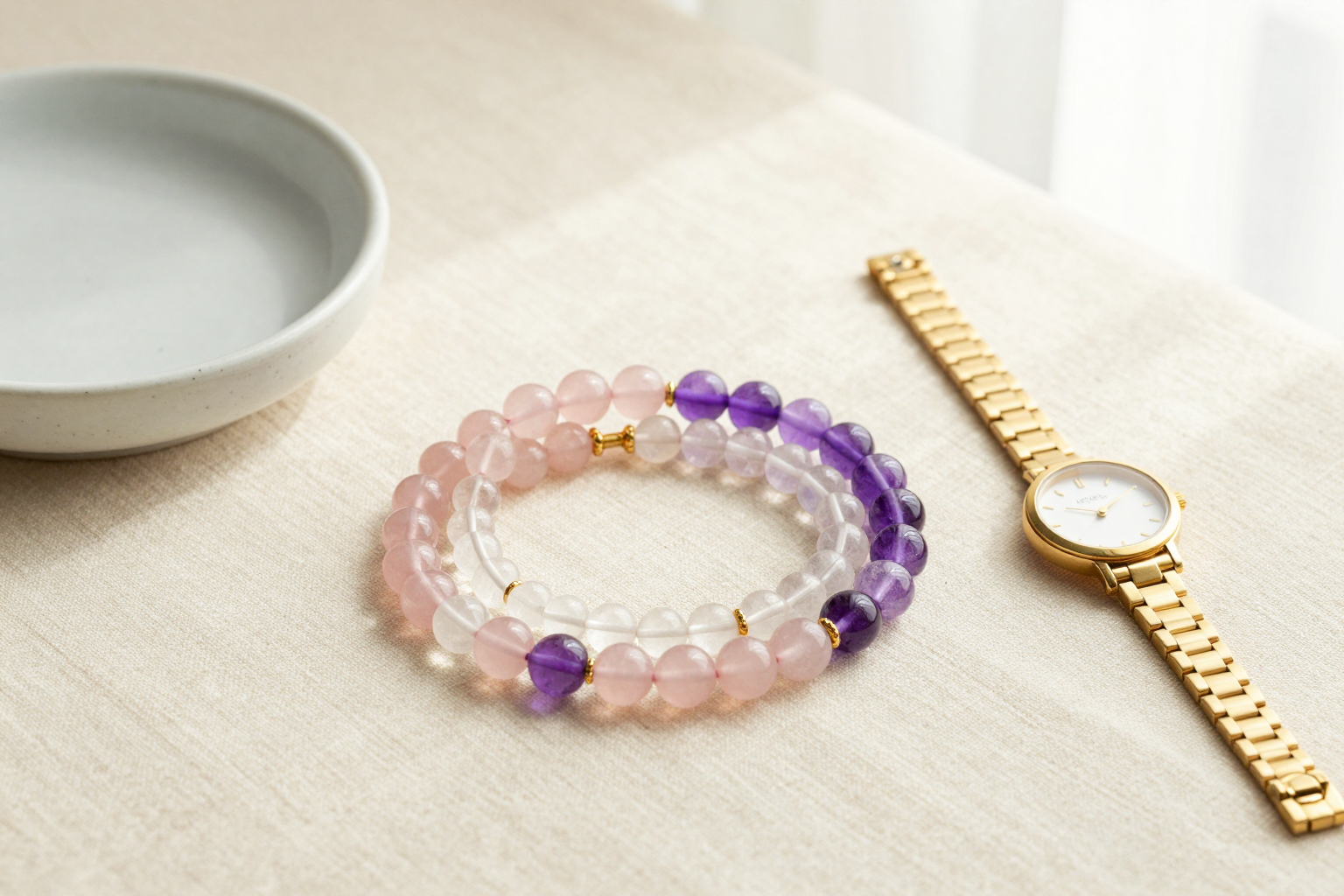
Crystal bracelets come with a lot of instruction attached: amethyst on the left, obsidian on the right, never stack more than three. Some of that has genuine cultural roots; some is retail folklore. Here is how to tell the two apart — and how to choose a wrist you will actually enjoy wearing.
Which Wrist Should You Wear a Crystal Bracelet?
There is no medical rule, and no stone can be damaged by the “wrong” wrist. In most traditions, receptive stones — amethyst, rose quartz, moonstone — sit on the left wrist to take energy in, while protective or grounding stones — obsidian, tiger’s eye, black tourmaline — sit on the right to let energy out. In daily practice, most people simply wear the bracelet on their non-dominant hand, which keeps it out of the way of writing, typing and cooking.
Quick Answer: Match the Stone to the Wrist
| What you want | Typical stones | Suggested wrist | Reasoning |
|---|---|---|---|
| Calm, sleep, emotional steadiness | Amethyst, moonstone, rose quartz | Left | Receptive stones are worn on the receiving hand |
| Grounding and protection | Obsidian, black tourmaline, tiger’s eye | Right | Protective stones are worn on the releasing hand |
| Focus and clear thinking | Clear quartz, lapis lazuli, fluorite | Left | Traditionally drawn inward for mental clarity |
| Confidence and outward action | Citrine, carnelian, pyrite | Right | Paired with the hand that “does” |
| You are left-handed | Any | Mirror the rule | Swap left and right so the logic stays intact |
| You wear a watch every day | Any | Opposite wrist | Stops metal and beads from grinding together |
Where the Left–Right Rule Actually Comes From
The convention is older than the modern crystal market. In yogic and tantric traditions, the left side of the body is associated with ida, a cooling, lunar channel, and the right with pingala, a warming, solar one. Receiving stones were placed on the lunar side; energising stones on the solar side.
Chinese practice expresses a similar idea more bluntly: left in, right out (左进右出). The left hand accepts what you want to invite — calm, love, clarity — and the right hand releases what you want to shed, which is why protective black stones are so often worn there.
Neither system is a scientific claim — no clinical trial shows that a bracelet’s position changes your physiology. What the rule provides is consistency: a small ritual that makes a piece feel intentional rather than decorative. Follow it where it helps, and let comfort break the tie.
The Left Wrist: The Receiving Hand
If your goal is something you want to bring in — rest, patience, self-compassion — the left wrist is the conventional choice. It also happens to be the practical choice for right-handed people, since the non-dominant arm takes far less impact during the day.
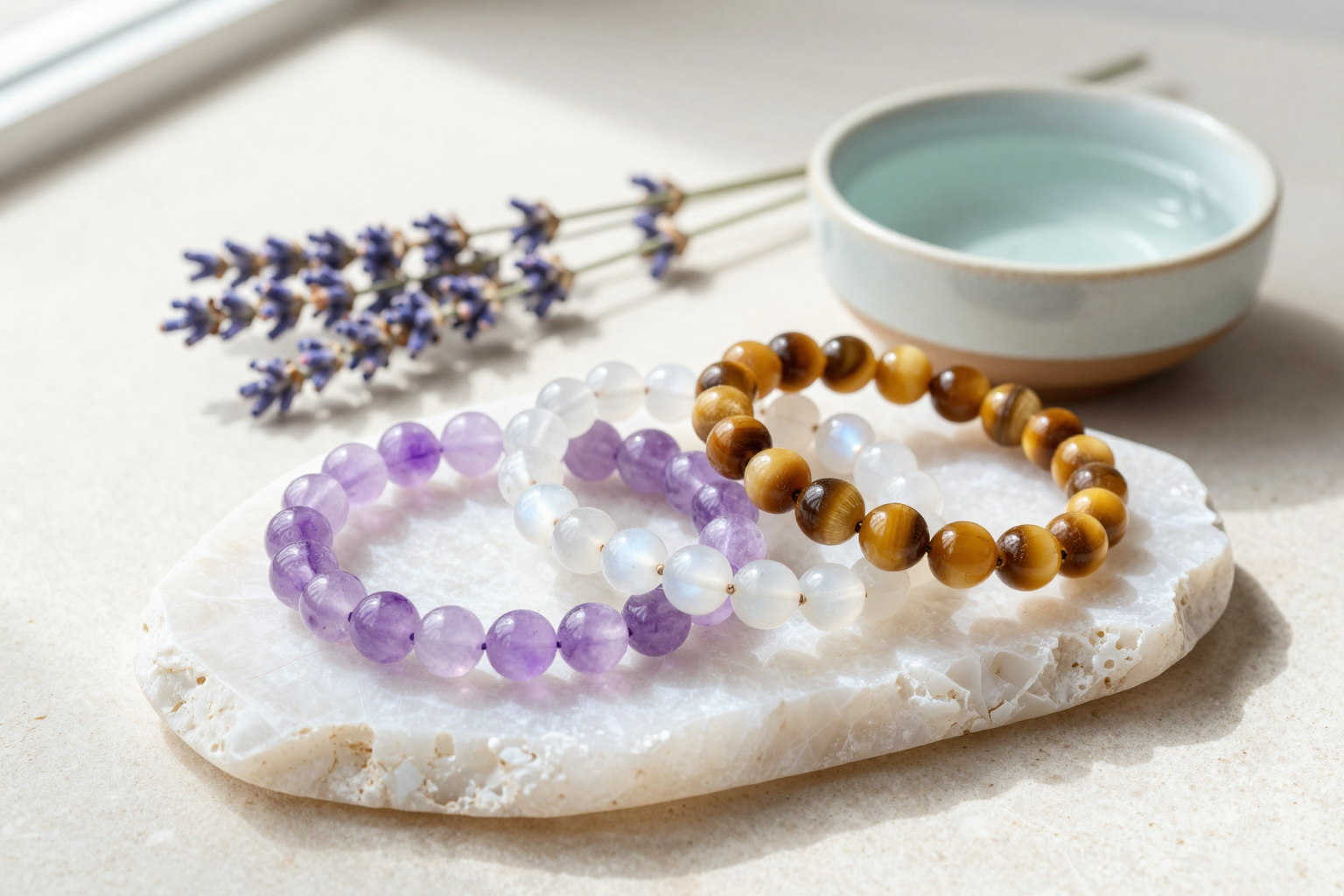
- Amethyst — the classic evening stone, associated with quieting a busy mind. Our amethyst guide covers grading and how to spot dyed beads.
- Rose quartz — worn on the left in most traditions as a stone of softness and open-heartedness. See the rose quartz properties guide.
- Moonstone — a lunar stone, and the one most often paired with the left wrist in sleep-and-cycle routines. Details in the moonstone article.
- Clear quartz — treated as an amplifier, so it is usually worn on the receiving side to “clear” what comes in.
- Lapis lazuli — a thinking stone for the desk, and a strong choice for the left wrist if you write with your right hand.
The Right Wrist: The Giving Hand
The right wrist carries stones whose job is boundary-setting: absorbing static, deflecting stress, keeping you grounded when a day gets loud. If you have ever felt calmer after putting on a heavy black bracelet before a difficult meeting, you already understand the appeal.
- Obsidian — the most common “right wrist” stone, worn for grounding and for cutting off mental loops. Read the obsidian guide.
- Tiger’s eye — a steady, decisive stone that many people wear on the working hand before negotiations. See tiger’s eye properties.
- Black tourmaline and hematite — heavy, dense beads that suit the releasing side and feel satisfyingly weighty.
- Citrine and carnelian — warm stones tied to momentum, often worn on the right by people who want to push work outward rather than inward.
The Practical Shortcut That Beats Every Rule
If you take nothing else from this article, take this: wear the bracelet on your non-dominant wrist unless you have a specific reason not to. Roughly nine in ten people are right-handed, which is why “left wrist” advice feels almost universal — it is partly tradition and partly the fact that most customers are not writing or using a mouse with that hand. That wrist also means fewer scratches, less contact with desk edges, and a lower chance the elastic stretches unevenly within a year.
Can You Wear Crystal Bracelets on Both Wrists?
Yes, and it is a common way to combine intentions — a calming amethyst on the left and a grounding obsidian on the right. Two limits are worth respecting: keep the total to one bracelet per wrist if the beads are 10 mm or larger, and avoid wearing two rigid or faceted pieces on the same arm, where they will chip each other. Stacking is a styling decision; chipping is permanent.
Layering Rules: How Many Bracelets Is Too Many
Three is the number most stylists settle on for a single wrist, and odd numbers generally photograph and sit better than even ones. Beyond that, a stack stops reading as jewellery and starts reading as clutter — and the beads take far more abrasion.
- Vary the scale. A 4 mm strand next to a 10 mm strand looks deliberate; three identical 8 mm strands look like a mistake.
- Keep one anchor piece. Let the crystal bracelet be the focal point and treat the chain or watch as support.
- Separate hard from soft. Quartz-family beads dull pearls, opals and amber over time, so give them their own wrist.
- Mind the metal. Warm stones such as citrine and tiger’s eye sit easily with gold; cool stones such as amethyst and lapis sit easily with silver.
- Hide the knot. Turn elastic bracelets so the knot faces the inside of the wrist.
Fit: The Detail That Decides Whether You Keep Wearing It
A bracelet that slides to your knuckles will be annoying by lunchtime, and one that leaves deep marks will not survive a full week. Most adult wrists fall between 14 and 19 cm; measure around the wrist bone with a strip of paper, then add roughly 1 cm for a comfortable elastic fit and 1.5–2 cm if you like a looser drape. You should be able to slide one finger under the strand without forcing it.
Bead size changes the feel as much as circumference does. An 8 mm strand is the everyday default, 10 mm reads as a statement, and 6 mm is the one you forget you are wearing. If you are between sizes, size up.
Choosing a Wrist by Zodiac or Element
If you already know which stone you want, the wrist question is settled by the sections above. If you are choosing the stone first, start from your sign: browse the twelve zodiac bracelet collections, or read the full zodiac crystal chart for a sign-by-sign comparison. Fire, earth, air and water signs each have a dedicated guide as well.
The five-element approach works differently — it looks at what your chart is missing rather than your sun sign. Wood, fire, earth, metal and water each map to particular stones; our five elements collection is organised that way, and the water element guide is a good place to see the logic in practice.
For group harmony rather than individual balance, the triple harmony bracelet pairs the three animals of a compatible group — and the older San He explainer covers the theory behind those combinations.
Everyday Situations: A Fast Reference
| Situation | What works | Why |
|---|---|---|
| Office and typing | Non-dominant wrist, 6–8 mm beads | Minimal desk contact, no clatter on the keyboard |
| Sleeping | Left wrist, smooth round beads | Fewer pressure points; avoid faceted or charm pieces |
| Gym and lifting | Remove, or wear a soft braided band | Bars and dumbbells crush beads and stretch elastic |
| Showering and swimming | Remove | Chlorine and repeated soaking degrade elastic and dull some stones |
| Formal events | One bracelet, opposite the watch | Cleaner line, and no metal-to-stone rubbing |
How Often to Cleanse by Wear Pattern
Wear pattern matters more than any fixed schedule. A bracelet worn daily against skin picks up lotion, sunscreen and sweat, so rinse it in lukewarm water and wipe it with a soft cloth weekly, with a fuller cleanse monthly. The full routine — water, salt, sound, moonlight, and the stones that should never be soaked — is in our crystal bracelet care guide.
Frequently Asked Questions
Does it matter which wrist you wear a crystal bracelet on?
Only if the tradition matters to you. Physically, either wrist is fine. The left-right convention is a cultural framework for intention, not a mechanism with measurable effects.
Should amethyst be worn on the left or right wrist?
Left, in most traditions, because it is treated as a receptive stone. If you are left-handed, the mirrored guidance puts it on your right wrist — the point is the non-dominant, receiving hand.
Can I wear a crystal bracelet on my right wrist if I am right-handed?
Yes. Many people do, especially with grounding stones like obsidian or tiger’s eye. Expect more surface wear and check the elastic more often.
Can I sleep in a crystal bracelet?
Smooth 6–8 mm beads are usually fine. Remove anything with faceted stones, charms or a metal clasp, which can press into the wrist or catch on bedding.
Should a crystal bracelet be tight or loose?
Snug but not compressive — you should fit one finger under the strand. Too tight restricts movement and marks the skin; too loose and the bracelet will slide over your hand.
Can I wear two crystal bracelets on the same wrist?
Yes, if the beads are small and the stones are of similar hardness. Avoid pairing faceted pieces, which chip each other, and rotate the stack so no single strand takes all the friction.
Wear It Where It Feels Right
Start with the tradition if it speaks to you, then adjust for the hand you actually use. The bracelet you keep wearing is the one that fits properly, sits clear of your watch and does not fight your sleeves — everything else is preference.
Not sure where to begin? Browse the zodiac sign collections for a stone matched to your sign, or explore the five elements range to balance your chart instead. Every bracelet is strung by hand and sized to your wrist.

 Please wait…
