No products in the cart.: $0.00

Crystal Bracelet Colors: What Each Color Means and How to Choose
What Do Crystal Bracelet Colors Mean?
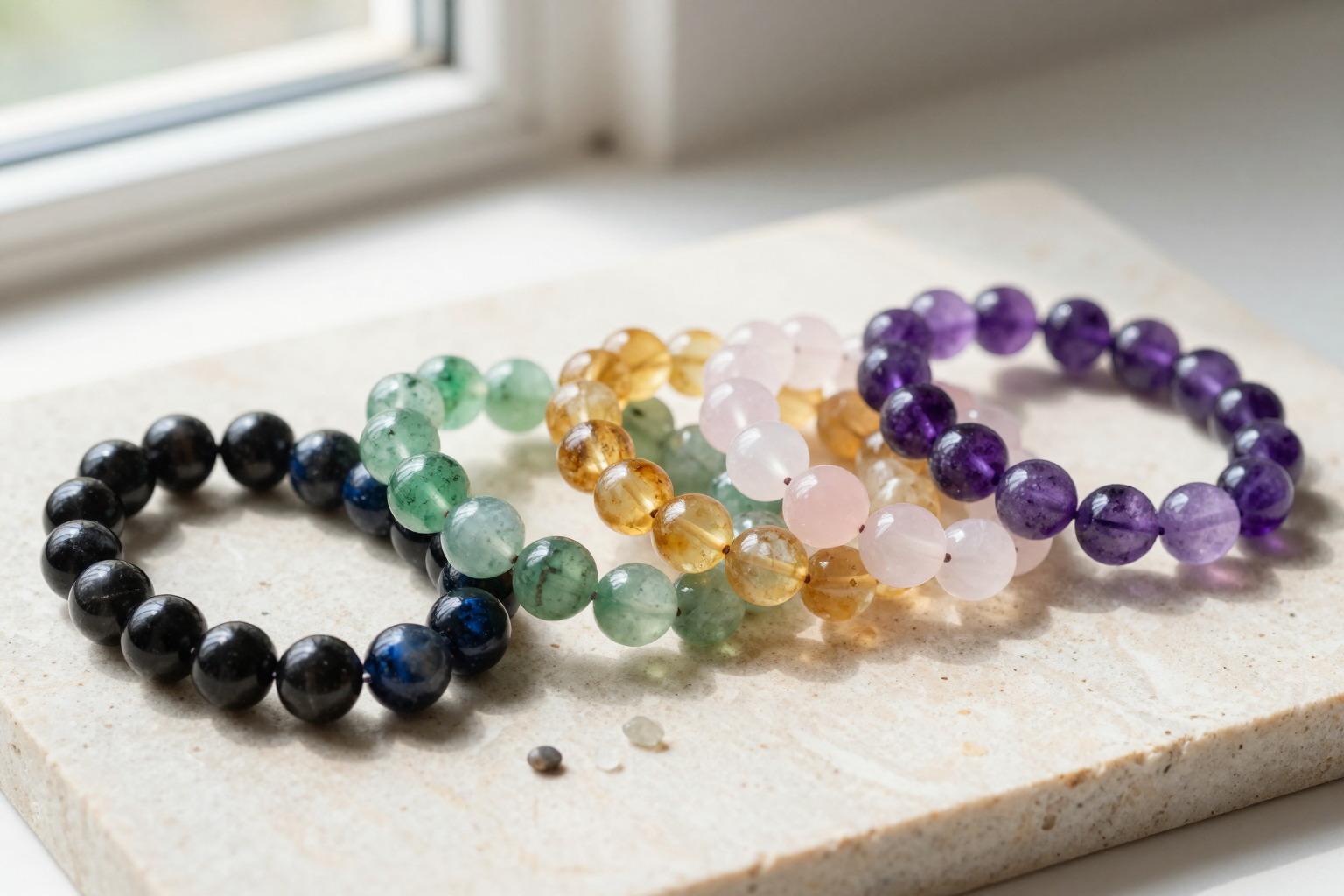
Color is the fastest way to read a crystal bracelet. In Chinese five-element tradition each color signals an element and a theme: black and blue point to Water, green to Wood, red and pink to Fire, yellow and brown to Earth, white and clear to Metal. Choose the color that matches the change you want.
That one rule explains most of what people mean when they say a bracelet “feels” protective or lucky. It also explains why a green aventurine strand and an emerald cuff are traditionally worn for the same purpose. Color carries the message; the stone is the messenger.
Quick Reference: Crystal Bracelet Colors at a Glance
| Color | Element | Core Meaning | Stones to Look For |
|---|---|---|---|
| Black, deep navy | Water | Protection, grounding, boundaries | Obsidian, black onyx, black tourmaline |
| Blue | Water | Calm, honest expression, flow | Lapis lazuli, aquamarine, blue lace agate |
| Green | Wood | Growth, health, steady money | Green aventurine, jade, malachite, moss agate |
| Pink | Fire (soft) | Self-worth, love, gentleness | Rose quartz, rhodonite, kunzite |
| Red, orange | Fire | Courage, vitality, passion | Carnelian, garnet, red agate, sunstone |
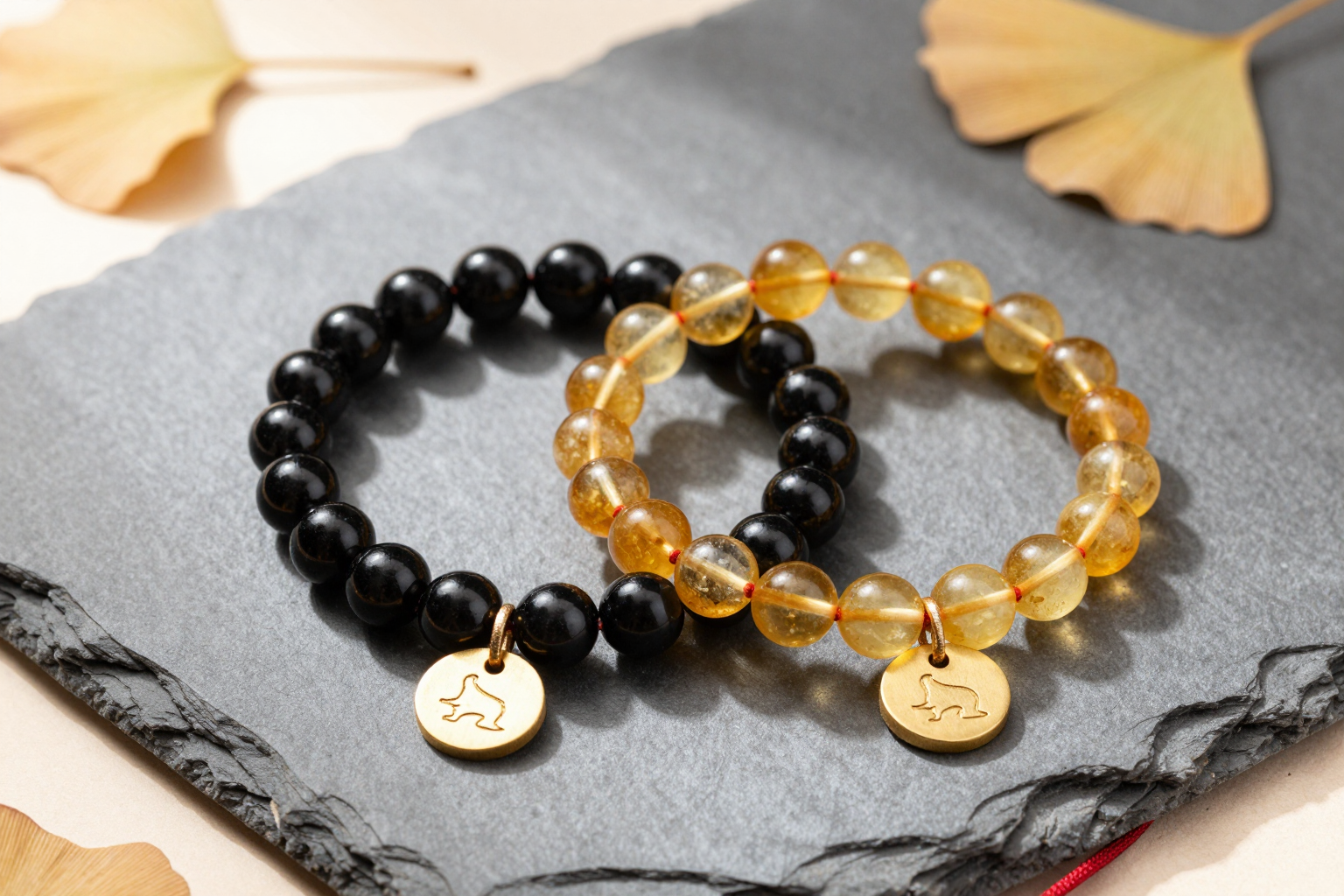
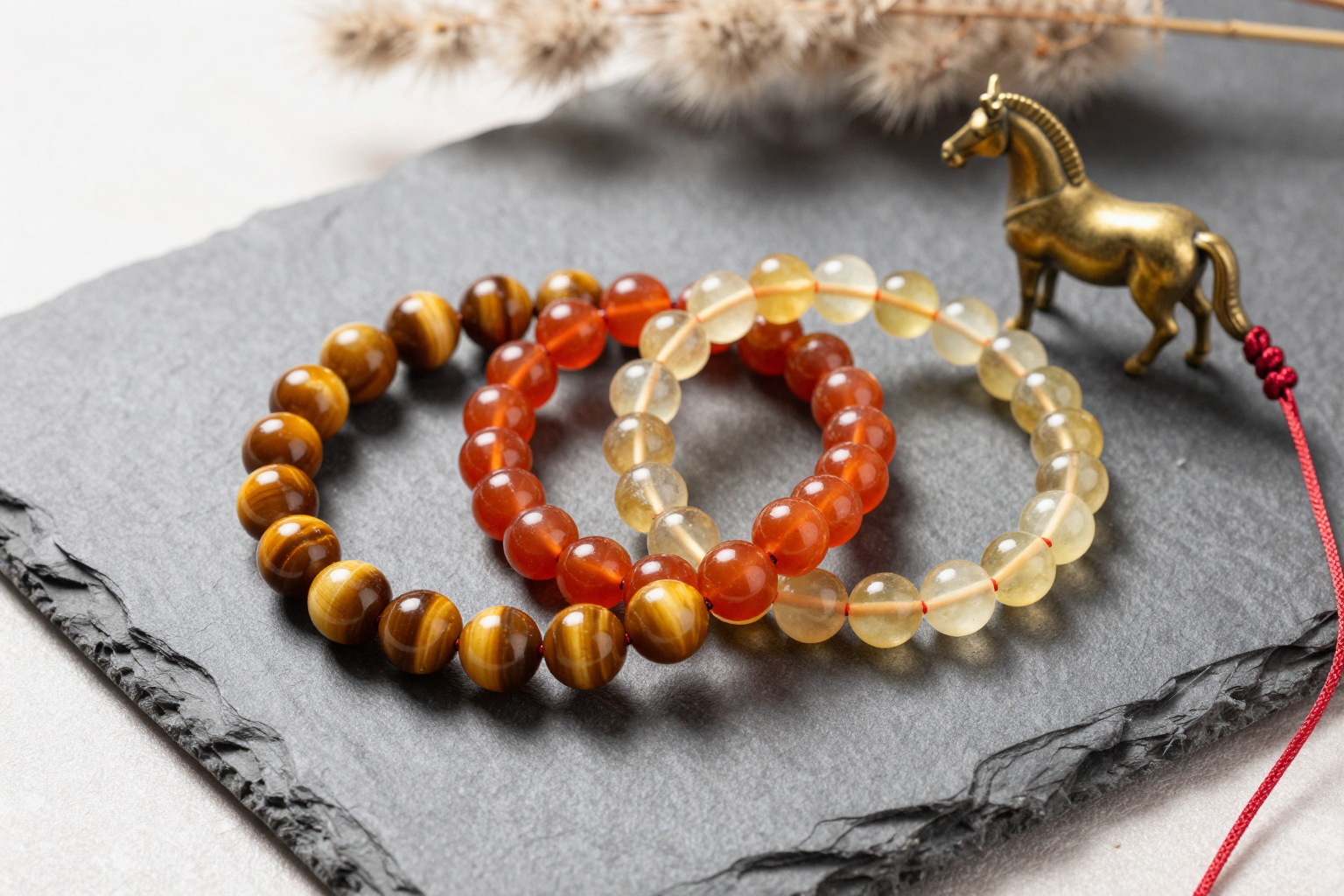
| Yellow, gold | Earth | Confidence, abundance, digestion | Citrine, tiger’s eye, yellow jasper, amber |
| White, clear, silver | Metal | Clarity, precision, reset | Clear quartz, moonstone, selenite, howlite |
| Purple, violet | Fire (yin) | Intuition, quiet mind, sleep | Amethyst, lepidolite, purple fluorite |
| Brown, smoky | Earth | Stability, release, endurance | Smoky quartz, bronzite, picture jasper |
If you are new to the system, our explainer on the generating and controlling cycles of the five elements shows which color families strengthen or restrain each other.
How Color Works in Crystal Bracelet Tradition
Two systems converge on the same answer. Western stone lore reads color through the chakras — red for the root, green and pink for the heart, blue for the throat, violet for the third eye. Chinese five-element theory reads color as the visible signature of an element. The overlap is striking: both treat green as the color of the heart and of growth, and both treat black as protective rather than gloomy.
Color is a starting point, not the whole story. Tiger’s eye is golden-brown, so it reads as Earth, yet its banded shimmer gives it a watchful quality most wearers file under protection. Labradorite looks grey until it flashes blue, which is why it is used for intuition rather than Metal’s precision. And intensity matters: pale rose quartz is a gentler stone than saturated garnet, though both belong to Fire. Use color to narrow the shelf, then read the stone.
Black and Deep Navy: Protection and Quiet Strength
Black is the most misunderstood color in crystal jewelry. It is not negative — it is absorbent, worn to keep other people’s moods and crowded rooms from settling on you. Obsidian is the classic: volcanic glass, used for cutting ties with habits that no longer serve you. Black onyx is the quieter, more formal option; black tourmaline is what people reach for in genuinely draining places. Black belongs to Water, which is why it pairs naturally with deep blue — browse the Water element collection for that cooling, boundary-setting quality as a set.
Blue: Calm, Expression and Clear Communication
Blue shares the Water family but works on another axis. Where black closes a door, blue opens a channel: honest speech, steady nerves, saying the hard thing without heat. Lapis lazuli is the historical stone of rulers and judges for exactly this reason — authority expressed as clarity, not force. Aquamarine suits people who go quiet under pressure; blue lace agate is the gentlest entry point. Wear blue when the challenge is verbal: presentations, negotiations, interviews, difficult family conversations.
Green: Growth, Health and Steady Money
Green is Wood, the element of expansion — roots pushing through soil, plans turning into structures. This is why Chinese tradition associates wealth with green rather than gold: money is meant to grow, not sit. Wood element bracelets lean on green aventurine for opportunity, jade for durable prosperity and moss agate for slow renewal. Green is also the color of recovery; after burnout or a long stretch of overwork, it is the least demanding thing you can put on your wrist. Avoid pairing it with heavy black if your goal is momentum.
Pink and Red: Love, Courage and Vitality
Pink and red are both Fire, but not interchangeable. Pink is Fire at rest — the warmth of being cared for, and of caring for yourself. Rose quartz is the standard, and its most useful application is not romance but self-criticism: it is what people wear when they need to stop speaking to themselves badly. Red is Fire in motion: courage, circulation, appetite for risk. Carnelian is the everyday choice for stamina; garnet burns slower and suits long projects; red agate is the traditional protective red behind Chinese New Year cords. If you already run hot or sleep badly, start with pink. Explore the Fire element collection for the full warm palette.
Yellow, Gold and Orange: Confidence and Abundance
Yellow and gold are Earth: harvested grain, stored wealth, the settled feeling of having enough. Citrine is nicknamed the merchant’s stone for good reason — it is the color people wear to be seen and paid. Tiger’s eye handles the other half of the job: spotting the opportunity in front of you and holding your nerve. This is the most extroverted family on the chart, excellent for sales and interviews, a poor fit if you want to be left alone. Yellow jasper is the grounded version — same family, far less flash.
White, Clear and Silver: Clarity and Boundaries
White and clear belong to Metal, the element of precision and clean edges. Clear quartz is the reference stone: it does not add a mood so much as amplify what is already there, which is both its strength and its risk — sharpening focused work, but making a chaotic week louder. Selenite is the reset button, often kept bedside or used to cleanse other pieces. Moonstone is the exception here: white in body, but emotional and cyclical in reputation. Because quartz is neutral, it is the best color to layer under a stronger one; see the Metal element collection.
Purple, Violet and Lilac: Intuition and a Quieter Mind
Purple is Fire in its yin form — heat turned inward, which is why it governs dreams, study and insight that arrives when you stop forcing it. Amethyst is the stone most people already own, and usually for sleep: worn on the left wrist in the evening, it is the traditional answer to a mind that will not switch off. Lepidolite is the softer, more soothing cousin; purple fluorite is the study stone. This is the family where less is more — one strand outperforms three.
Brown, Smoky and Earth Tones: Grounding and Letting Go
Brown is Earth at its plainest: soil, patience, endurance. Smoky quartz is the workhorse, traditionally worn through grief, job loss and other slow transitions — not because it fixes anything, but because it takes the edge off. Bronzite and picture jasper carry the same steadiness with more texture. If you have ever put on a bracelet and felt immediately calmer, it was probably one of these; Earth element stones are the right first purchase for anyone who feels scattered or permanently behind.
How to Choose Your Color
Start with the change you want
- Better sleep: amethyst, lepidolite, moonstone.
- Focus: clear quartz, fluorite, sodalite.
- Money and career momentum: citrine, green aventurine, tiger’s eye.
- Love, including self-respect: rose quartz, rhodonite.
- Protection in draining environments: obsidian, black tourmaline, smoky quartz.
- Confidence before a big moment: carnelian, sunstone, red agate.
Or start with your zodiac sign
Zodiac traditions already assign colors: fire signs lean warm, water signs dark and blue, earth signs green and brown, air signs pale and clear. Our zodiac crystals chart lists primary and supporting stones for all twelve signs, and the zodiac bracelet guide covers sizing and stacking. A Scorpio is matched with obsidian and labradorite, a Libra with lapis and opal — pairings that make sense the moment you look at the colors.
Or start with your five-element balance
If you know which element is weak, wear its color. If you do not, choose by symptom: restlessness points to excess Fire, rigidity to excess Metal, feeling unmoored to too little Earth. Our guide to restoring a five-element deficiency walks through the logic. The one mistake to avoid is feeding a strength — adding red to someone already volatile tends to make the week worse.
Wearing More Than One Color
Multi-color wrists work when one color leads: one dominant stone, one supporting stone from a neighbouring element, and one neutral — usually clear quartz — as a bridge. Two colors of similar intensity compete; three strong colors become noise. A triple harmony bracelet is already balanced on that principle. For the mechanics, see our guide to stacking crystal bracelets.
Frequently Asked Questions
What color crystal bracelet is best for a beginner?
Clear quartz, or a single-color bracelet in the shade you are most drawn to. One stone worn consistently beats a stack chosen by other people’s recommendations.
Does bead color matter more than the type of stone?
Stone first, color second. Jade and malachite are both green but behave differently — durable prosperity versus decisive change — so let the stone set the intention and use color to confirm the family.
Can I wear a black crystal bracelet every day?
Yes. Black carries no traditional wearing restriction, and daily wear is how most people use obsidian or onyx. Cleansing it monthly is enough.
What color should I wear for money?
Green for growth and long-term accumulation, yellow or gold for visibility and immediate opportunity. Many people wear citrine for negotiations and green aventurine the rest of the year.
Do I have to match the color to my zodiac sign?
No. Zodiac matching is a shortcut for people who like a framework. If a stone’s color and meaning fit what you are working on, that is a stronger signal than a chart.
Which wrist should I wear it on?
Tradition holds that the left wrist receives energy and the right projects it, so calming colors like amethyst usually go left and active colors like carnelian go right. Our left versus right wrist guide explains the reasoning.
Choose the Color You Will Actually Wear
The best color is the one that stays on your wrist. A bracelet chosen purely for its meaning and left in a drawer does nothing; one chosen because you like how it looks gets worn daily, and daily wear is where the tradition actually lives. Start with one color, wear it for a month, and notice whether the week feels different.
Browse our five element crystal bracelets to shop by color family, or explore the zodiac sign collections if you would rather start from your sign.

 Please wait…
