No products in the cart.: $0.00

Heart Chakra Crystals: Best Stones for Love, Compassion and Connection
Heart Chakra Crystals: The Short Answer
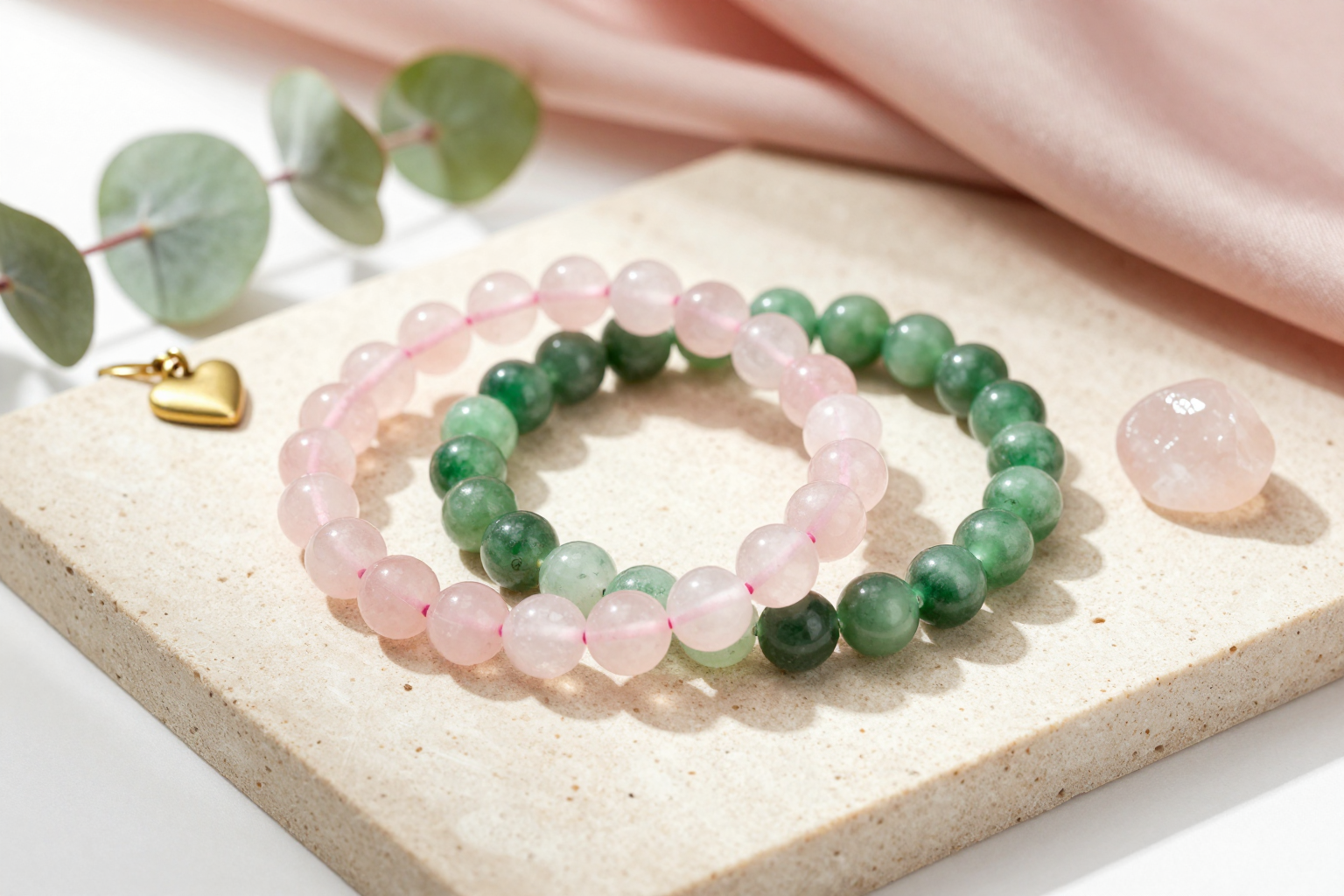
The best heart chakra crystals are rose quartz for self-love, green aventurine for emotional calm, rhodonite for healing old hurt, rhodochrosite for self-worth, malachite for releasing what you have outgrown, and jade for steady, quiet warmth. A heart chakra bracelet works best on the left wrist, worn daily rather than occasionally.
The heart chakra, called Anahata in Sanskrit, sits at the centre of the chest and governs how you give and receive love — toward other people, and just as importantly toward yourself. It is the fourth of the seven centres: the bridge between the grounding lower chakras and the expressive upper ones, and the hinge the whole system turns on in our seven chakra bracelet guide.
Quick Answer Table
| Stone | Colour | Best for | Feels like |
|---|---|---|---|
| Rose quartz | Soft pink | Self-love, gentleness, romantic openness | A warm hand on your shoulder |
| Green aventurine | Pale mint green | Emotional calm, optimism after stress | A slow exhale |
| Rhodonite | Pink with black veining | Healing old hurt, forgiveness | Closing a chapter |
| Rhodochrosite | Banded rose pink | Self-worth, childhood wounds | Being allowed to want things |
| Malachite | Banded green | Release, boundaries, growth | Clearing out a crowded room |
| Jade | Deep green | Steady warmth, loyalty, long relationships | Something that lasts |
What the Heart Chakra Actually Governs
Anahata is associated with green (and, in modern practice, pink as its softer expression), the element of air, and the physical heart and lungs. Its themes are compassion, empathy, forgiveness, and the capacity to stay open without becoming porous — to love people without absorbing their chaos. Most people who feel “blocked” here are not short of love; they are either defended against it or giving it away faster than they can refill. The stones below split into two jobs: opening (rose quartz, rhodochrosite) and protecting while open (malachite, rhodonite).
The Six Best Heart Chakra Stones
1. Rose Quartz — The Baseline Stone
Rose quartz is the most-used heart stone on earth: gentle enough to wear daily, broad enough to suit almost any intention. Its pink comes from trace titanium, iron or manganese, and the best pieces have a cloudy translucency rather than flat candy pink.
Wear it when the issue is how you speak to yourself. In practice people notice it in hindsight: a week of rose quartz often reads as “I stopped being so harsh in my own head.” Pair it with citrine and you have the heart and the wallet in one conversation — see our rose quartz and citrine pairing guide.
2. Green Aventurine — The Calming Stone
Green aventurine is quartz filled with tiny mica platelets that give it a shimmer called aventurescence. It is a soft, optimistic green — closer to new leaves than to emerald.
Choose it when the heart issue is really a nervous system issue: you are coming off a hard season, you feel raw, and you need soothing rather than stimulating. It stacks with almost anything because its energy is undemanding.
3. Rhodonite — The Stone for Old Hurt
Rhodonite is rose pink with black manganese oxide veins running through it — beauty with the damage still visible. Good pieces are opaque with clear, distinct veining rather than muddy colour.
Reach for it after a breakup, a friendship that ended badly, or a family wound you keep circling. It is paired with the intention of forgiveness, not because you must forgive, but because carrying the grievance has become heavier than the event.
4. Rhodochrosite — The Self-Worth Stone
Rhodochrosite forms in banded layers of rose pink and cream, and at Mohs 3.5–4 it is much softer than quartz. That softness is a practical warning: it scratches, and it does not belong on a wrist that bangs against a desk all day unless the beads are well protected.
Its traditional association is with the inner child and with feeling allowed — allowed to want, to rest, to be liked without earning it. Wear it if you notice yourself over-explaining.
5. Malachite — The Release Stone
Malachite’s swirling green bands make it one of the most recognisable stones in any crystal shop, and its heart work is a clear-out rather than a comfort: breaking patterns, setting boundaries, and letting go of relationships or habits that have run their course.
Handle it with care — malachite is copper-based and relatively soft, so never soak it in water or salt. Wipe with a dry or barely damp cloth and keep it away from perfume.
6. Jade — The Long-Game Stone
Jade has been worn in East Asia for thousands of years as a stone of steadiness, health and loyalty, and it behaves differently from the pink stones here: it does not open you up, it makes openness safe. If your heart work is staying in a long marriage, friendship or caretaking role without burning out, jade is the more durable choice.
In the Chinese five-element system jade belongs to wood, the element of steady growth. See our wood element collection if you want to build a bracelet around that logic rather than the chakra one.
Signs the Heart Chakra Is Out of Balance
Traditional chakra writing splits imbalance into two directions, and the distinction is useful when choosing a stone.
| Deficient (closed) | Excessive (over-giving) |
|---|---|
| Difficulty trusting, keeping people at arm’s length | Boundary collapse, saying yes to everything |
| Feeling numb or flat about relationships | Absorbing other people’s moods as your own |
| Judging yourself harshly and quickly | Resentment that builds silently, then erupts |
| Discomfort receiving help or compliments | Exhaustion after social contact |
If you recognise the left column, lean towards rose quartz and rhodochrosite. If you recognise the right, start with malachite and rhodonite, then add green aventurine to settle the nerves. For a broader look at how colour maps onto intention, see what each crystal bracelet colour means.
How to Choose Your Stone
- By intention, not by shade. Pink for self-directed work, green for outward-facing and boundary work.
- By hardness if you are rough on jewellery. Rose quartz, aventurine and jade (Mohs 6.5–7) tolerate daily desk work; rhodochrosite and malachite (3.5–4) do not.
- By bead size. 8 mm is the safest everyday size for most wrists, 6 mm if you plan to stack three or more strands.
- By skin tone if you care how it looks. Warm undertones suit the pink stones, cool undertones pull green off beautifully — see colours for your skin tone.
How to Wear a Heart Chakra Bracelet
Which wrist?
The convention in crystal practice is to wear receiving stones on the left wrist and releasing stones on the right — so rose quartz, rhodochrosite and jade on the left, malachite on the right if you are actively clearing something out. There is no penalty for doing the opposite; comfort and consistency matter more. Our left vs right wrist guide explains the reasoning.
When to wear it
Heart work is a baseline practice, not a ritual, so the answer is simply: continuously. If you prefer a specific window, the evening is the most useful one — the heart centre is easiest to work with when you are not performing for anyone.
Stacking
Heart stones stack well with throat chakra stones (aquamarine, blue lace agate) because honesty and warmth reinforce each other, and with root stones when the openness needs to feel safe. Keep it to three strands; beyond that beads start chipping each other. See our stacking rules and pairings guide.
Heart Chakra and the Zodiac
In Western astrology the heart centre is most often linked to Libra, ruled by Venus and preoccupied with partnership, and to Taurus, Venus again but expressed through the body and through loyalty. Both respond well to rose quartz and jade — see the Libra collection and the Taurus collection. Water signs (Cancer, Scorpio, Pisces) feel heart stones strongly too, but usually need a darker stone alongside for protection.
If you are shopping for a gift and want the heart theme without another rose quartz bracelet, the triple harmony bracelets pair three zodiac allies on one strand and are the more distinctive option.
Care Notes
Rose quartz and aventurine fade slowly in prolonged direct sun, so store them out of it. Rhodochrosite and malachite should never be soaked, salted or cleaned ultrasonically — wipe only. Jade tolerates a rinse and a soft brush. For cleansing rhythms that will not damage soft stones, see our crystal bracelet care guide.
Five Things to Skip
- Wearing six strands at once. More stones is more noise and more chipped beads, not more love.
- Buying dyed “rose quartz.” Vivid, uniform hot pink with no cloudiness is usually dyed quartz or glass.
- Soaking malachite to “cleanse” it. Water and copper-based stones do not mix.
- Treating the bracelet as a substitute for a conversation. It supports the work; it does not do it for you.
- Ignoring fit. A bracelet that rattles over your hand is one you will keep taking off.
Frequently Asked Questions
Which crystal is best for the heart chakra?
Rose quartz is the most widely used and the safest starting point: one stone that covers self-love, gentleness and general openness. Add green aventurine if you also need calm, or rhodonite if there is specific hurt to work through.
Should I wear a heart chakra bracelet on the left or right wrist?
Left, by the common convention, because the left side is associated with receiving energy. Wear it on the right if you are using it to release something — a pattern, a grudge, a relationship that has ended. Consistency matters more than the rule.
Can I wear rose quartz and malachite together?
Yes, and it is a sensible combination: rose quartz opens, malachite clears. Keep them on separate wrists, and remember malachite needs dry handling — no shower, no gym.
How long does it take to notice a difference?
Most people describe changes in weeks rather than days, and usually in hindsight. Crystal work is an attention practice as much as anything else; the stone is a reminder to check how you are treating yourself and the people around you.
Does the heart chakra crystal need to touch the skin?
No. Many people wear bracelets over a sleeve and report no difference. Proximity and consistency matter, not direct contact.
Can men wear heart chakra bracelets?
Of course. If pink feels wrong, green aventurine, jade and malachite carry the same association in a darker palette; 10 mm beads read as more substantial than 6 mm.
Where to Start
If you are new to this, start with one strand and wear it for a month before adding anything — rose quartz if the work is internal, green aventurine if you mostly need to stop feeling braced. Browse the HoldFate crystal bracelet collection to see the stones side by side, or read more in our crystal knowledge archive.

 Please wait…
