
No products in the cart.: $0.00

Moonstone and Labradorite Together: The Intuition Pairing
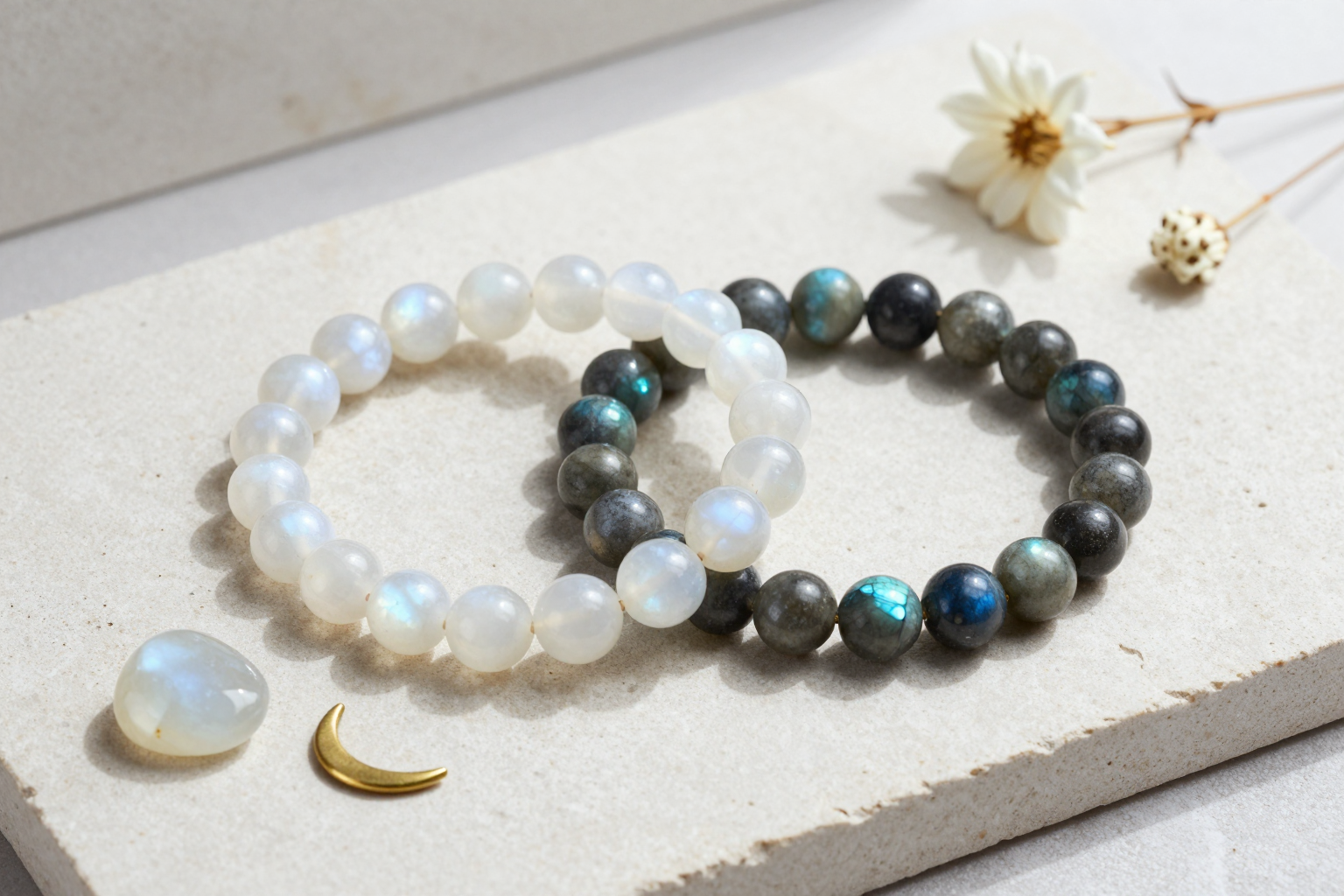
Do Moonstone and Labradorite Work Together?
Yes. Moonstone and labradorite are both feldspars, so they share a cool, quiet temperament rather than fighting for attention. Moonstone opens you to subtle impressions and softens emotional static; labradorite filters those impressions and holds a boundary around your energy. Together the pair reads as intuition with protection built in — which is why so many people wear them as a set.
Moonstone vs Labradorite at a Glance
| Moonstone | Labradorite | |
|---|---|---|
| Core role | Receptive calm and emotional steadiness | Shielded insight and clear boundaries |
| Chakra focus | Third eye, with a soft pull on the sacral | Third eye and throat |
| Traditional element | Water | Air, or metal in the Five Elements framing |
| Best wrist | Left, the receiving side | Left for inner work; right when you want the shield facing outward |
| Best moment | Evening, new moon, winding down to sleep | Morning, crowded rooms, decisions that need nerve |
| Suits | Restless sleepers, people in emotional transition | Empaths, overthinkers, creatives, anyone in a noisy environment |
| Handling | Mohs 6–6.5; avoid knocks and ultrasonic baths | Mohs 6–6.5 with real cleavage; never ultrasonic or salt-soaked |
What Each Stone Brings on Its Own
Moonstone: the quiet receiver
Moonstone is the stone most often handed to someone who cannot switch off. Its adularescent sheen — that drifting blue-white glow that seems to sit just under the surface — has been read for centuries as moonlight trapped in stone, and the associations followed: tides, cycles, rest, and the parts of your life that move at their own pace whether you approve or not.
In practice, people reach for it when the emotional volume is too high. It is a steadying stone rather than a stimulating one, which is why it pairs so naturally with sleep, with hormonal cycles, with grief, and with the first weeks of any big change. If you want the full breakdown of the stone itself, our moonstone meaning and properties guide covers its history and traditional uses in more depth.
Labradorite: the observer behind glass
Labradorite looks unremarkable until the light hits it at the right angle, and then a blue-green flash opens across the surface. That quality is the whole metaphor: ordinary from one position, luminous from another. It has become the default stone for people who absorb too much from the room and need to watch without being flooded.
Traditionally it is treated as a stone of the third eye with a protective edge — good for intuition, good for boundaries, not especially soft about either. Our labradorite meaning guide goes further into its folklore and the reasons it is so often recommended to empaths.
Why the Pairing Holds Up
Intuition with a filter
Most intuition stones have the same weakness: they open you up without teaching you what to do with the volume. Labradorite is the rare partner that closes the loop. Moonstone widens the channel, labradorite decides what is worth letting through. Anyone who has ever felt psychic in a crowded room and exhausted an hour later understands the difference.
A calmer nervous system, a clearer read
Neither stone is energising in the way citrine or carnelian is. Both sit in the cool, still register, and that shared register matters. Wearing two stones that both calm the system reinforces the effect instead of splitting it, which is why this pair feels seamless on the wrist while a moonstone-and-garnet stack can feel argumentative.
Strong company for dreamwork and creative flow
This is the most common reason people combine them. Moonstone is traditionally kept near the bed for dreams and recall; labradorite is kept close for the flash of insight that arrives just before sleep or just after waking. Put together, they cover both ends of that window, which is why writers, designers and anyone doing intuitive work tend to keep them within reach.
Who Gets the Most From This Pair
Highly sensitive people and empaths
If you leave gatherings drained, or you catch a mood before anyone says a word, this is close to an ideal combination. The labradorite does the boundary work; the moonstone stops the boundary from turning into numbness.
People in the middle of a transition
New city, new job, end of a relationship, first year of something. Moonstone is a change stone in the gentlest sense — it does not push, it steadies. Labradorite adds the nerve to keep going when the ground is still moving.
Creatives who work from instinct
Designers, writers, musicians and anyone whose best ideas arrive sideways. The pairing is less about productivity and more about keeping the channel open without burning out the receiver.
How to Wear Moonstone and Labradorite Together
Option 1: one bracelet, both stones
The tidiest option and the one most people end up choosing. A mixed strand with pale moonstone beads spaced among darker labradorite keeps both stones in constant contact with the skin and reads as a single deliberate piece rather than two competing ones. Aim for a 7:3 or 6:4 ratio so the paler stone does not get visually swamped.
Option 2: two bracelets on the same wrist
Works well if you already own both separately. Stack the moonstone closer to the hand and the labradorite above it, so the protective stone sits nearer the elbow. Keep the bead sizes within 2mm of each other, and if either bracelet has a charm or a heavy clasp, wear that one on the outside to avoid abrasion. Our stacking rules guide covers friction, colour balance and the over-stacking point in more detail.
Option 3: split across both wrists
Reserved for days when you want the two functions separated. Moonstone on the left for receptivity, labradorite on the right for the outward-facing shield. It is a slightly more deliberate choice than stacking, and it is the setup many long-term wearers settle into for workdays. If you are still deciding which side is which, our left versus right wrist guide explains the traditional reasoning.
Zodiac and Element Notes
Moonstone is the traditional stone of Cancer and a natural fit for Pisces — both water signs that run on feeling rather than analysis. Browse the Cancer crystal bracelets or the Pisces crystal bracelets if you want the pairing built around a sign. It is also the modern June birthstone, which makes it a common gift stone — see the birthstone colour chart for how it sits against the rest of the year.
Labradorite leans airy and cool, and in a Five Elements framing it reads as metal: clarifying, cutting, separating signal from noise. If you like building a stack around element balance, the water element collection is the natural home for the moonstone half of the pair, while the metal element collection covers the labradorite side.
Care for Both Stones
Both are feldspars at Mohs 6 to 6.5, which puts them in the “be gentle” bracket. Warm water, a drop of mild soap and a soft cloth is the whole routine. Skip ultrasonic cleaners and salt soaks — salt is harsh on labradorite’s surface and can cloud the polish on either stone. Store them separately or in a soft pouch, because feldspar chips at the edges when it knocks against harder quartz. Moonstone responds well to moonlight; labradorite prefers indirect light and dislikes long exposure to direct sun. The full routine is in our crystal bracelet care guide.
Five Mistakes to Avoid
- Wearing both to bed. Moonstone is fine overnight; labradorite tends to keep the mind ticking. Take the labradorite off and leave the moonstone on.
- Assuming they are interchangeable. They overlap on the third eye but do opposite jobs — one opens, one filters. Choose by the day, not by the mood.
- Stacking them with heavy quartz. Clear quartz and amethyst at Mohs 7 will scratch both stones over months of contact.
- Cleansing with salt water. The most common way to dull a labradorite flash.
- Buying a labradorite with no flash. Grey stone with a weak sheen is still labradorite, but the character that makes the pairing work comes from that blue-green fire. Check it in daylight before you buy.
Frequently Asked Questions
Can moonstone and labradorite be worn on the same wrist?
Yes, and it is the most common arrangement. Keep bead sizes close, put the labradorite above the moonstone, and avoid pairing either with a hard quartz bracelet that will abrade them.
Which stone should go on the left wrist?
Moonstone, in the traditional left-is-receptive reading. Labradorite can go on either side; put it on the right when you want the protective quality facing the outside world.
Is this pairing good for sleep?
Moonstone alone, yes. Labradorite is better kept off the bedside table if you already struggle to fall asleep — it is a waking stone for most people. Try moonstone overnight and labradorite from morning onward.
Do they have to be cleansed differently?
The method is the same, but the limits are stricter for labradorite. Both take lukewarm water and a soft cloth; neither should go in an ultrasonic cleaner or a salt bath, and neither likes being left in direct summer sun.
Can I add a third stone to this pair?
Yes. Clear quartz amplifies both but risks scratching them, so use a spacer. Amethyst adds a calmer third-eye note and works well as a single accent bead. Obsidian overcorrects — three protective stones together usually feels heavy rather than balanced.
Is one of them better for anxiety?
Neither replaces medical care. Within the tradition, moonstone is the one recommended for emotional steadiness and labradorite for the overstimulation that comes from other people. The pair is popular for exactly that split.
Where to Start
If you are choosing one piece rather than two, start with a mixed strand so both stones live on the same elastic. Browse the full crystal bracelet shop for ready-made pairings, or read more stone-by-stone guides in our crystal knowledge library. Either way, buy the labradorite in daylight — the flash is the point.

 Please wait…
