
No products in the cart.: $0.00

Grounding Crystal Bracelets: Root Chakra Stones for Stability and Calm
Do grounding crystal bracelets actually work?
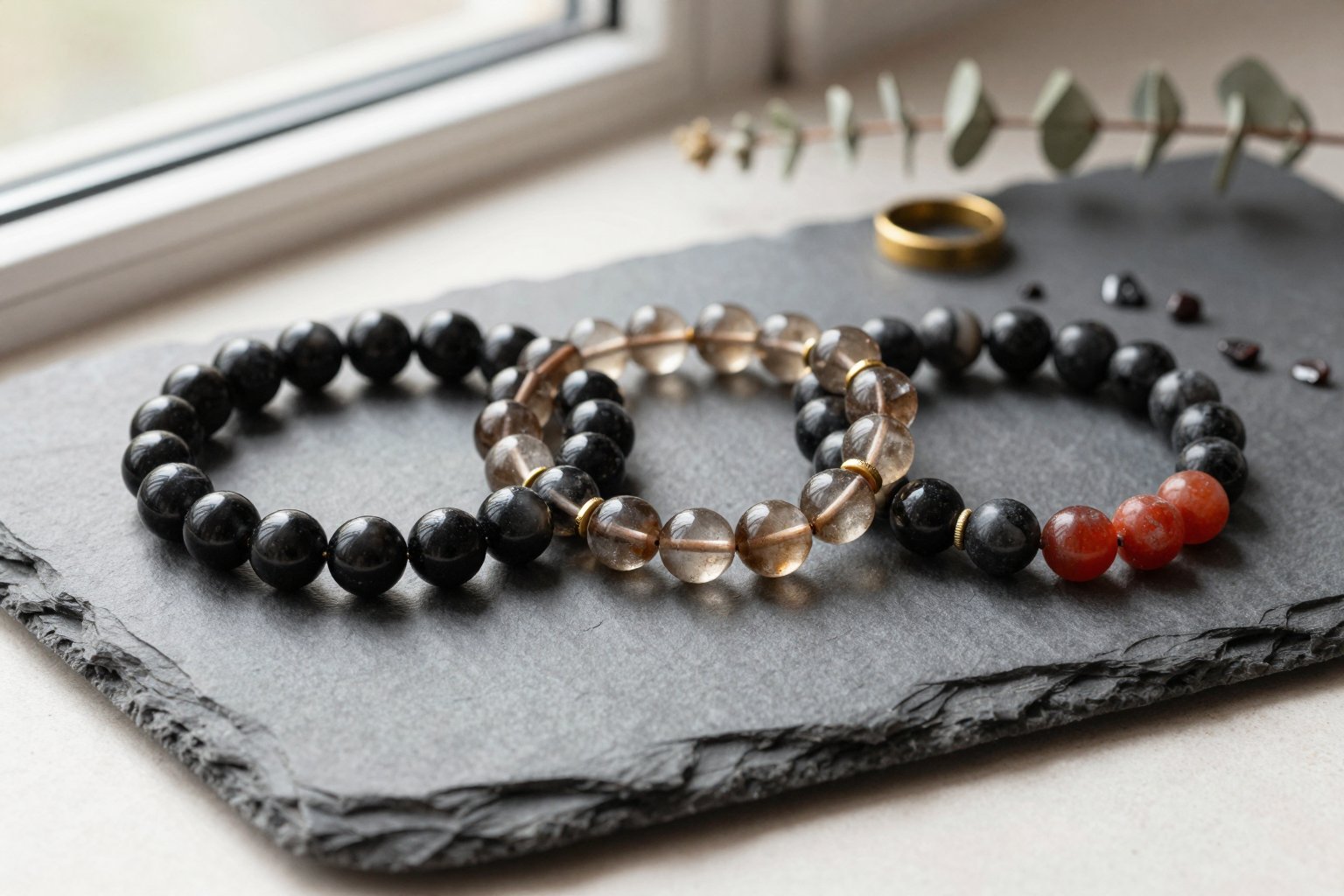
A grounding crystal bracelet is worn to counter the feeling of being scattered, wired or unsteady. The tradition pairs dark, dense stones — black obsidian, smoky quartz, hematite, black tourmaline — with the root chakra at the base of the spine, and wearers use the bracelet as a physical cue to slow down, breathe and return attention to the body. Think of it as a reminder you can feel, not a medical treatment.
Grounding stones at a glance
| Stone | Color | Best for | Feel |
|---|---|---|---|
| Black obsidian | Glossy black | Overstimulation, boundaries | Fast, sharp, decisive |
| Smoky quartz | Smoky brown | First-timers, low-grade static | Soft, steady, quiet |
| Black tourmaline | Matte black | Crowds, noise, busy workplaces | Protective, enclosing |
| Red jasper | Brick red | Fatigue, low motivation | Warm, slow, physical |
| Hematite | Gunmetal grey | Racing thoughts, mental loops | Heavy, cool, mirror-like |
| Tiger’s eye | Gold-brown bands | Grounded action at work | Confident, forward |
What “grounding” means in crystal practice
In chakra tradition, the root chakra (muladhara) sits at the base of the spine and governs the most basic questions a person asks: am I safe, am I supported, do I belong here. When that center is described as weak, the language is familiar — anxious, unmoored, unable to finish anything, sleeping badly but exhausted all day. When it is described as balanced, the language is equally familiar — calm, steady, able to say no.
Grounding is the practice of moving attention downward. Crystal tradition reads stone qualities symbolically as well as visually: dark, opaque, heavy stones are associated with the lower body and the earth, while pale, translucent stones are associated with the upper centers and the mind. That is why a grounding bracelet almost always looks the same — deep blacks, browns, brick reds and gunmetal greys, often opaque, often with visible weight.
None of this replaces medical care. What a bracelet does is give an abstract intention a physical form: you feel the beads, you remember the plan you made, you take one slow breath. That loop is the actual mechanism, which is why the stone matters less than noticing it.
The best grounding stones for a root chakra bracelet
Black obsidian
Obsidian is volcanic glass, cooled so quickly that it never crystallized. It is the most direct of the grounding stones and the least subtle: people usually describe it as a hard stop rather than a slow settling. That makes it useful for overstimulation — the hour after a difficult meeting, the end of a travel day, the evening after too much screen time. It is also the stone most often chosen for boundary work, because its association is with protection rather than comfort. For a deeper look at how obsidian behaves next to a warmer stone, see our guide to black obsidian and tiger’s eye worn together.
Smoky quartz
Smoky quartz is the gentlest entry point and the one we recommend most often for first-time buyers. Its color comes from natural irradiation in the earth, and its reputation is for clearing low-grade static rather than confronting anything dramatic — the difference between opening a window and pulling a fire alarm. It also carries an earth-element association, which makes it an easy match for anyone who already wears brown, bronze or taupe jewelry.
Black tourmaline
Black tourmaline is the stone people reach for in crowds. It is matte rather than glossy, opaque to the point of absorbing light, and traditionally described as protective in the enclosing sense — a wall rather than a blade. In practice it is the best choice for commuters, open-plan offices, hospital shifts and anyone who comes home from a public space feeling wrung out.
Red jasper
Red jasper is the warm end of the grounding spectrum. Where obsidian cuts and tourmaline shields, jasper rebuilds — it is the stone chosen by people who feel flat rather than frantic, depleted rather than overstimulated. Its iron content gives it the brick-to-rust color range that has made it a root chakra staple for centuries, and it pairs naturally with carnelian and garnet if you want a slightly more energizing red stack.
Hematite
Hematite is the heaviest-feeling stone on this list, and that is its whole argument. Metallic grey, often with a mirror-like polish, it is traditionally used for mental looping — the 2 a.m. replay of a conversation you cannot change. The weight is the point: it makes the hand feel anchored.
Tiger’s eye and garnet
Tiger’s eye sits between grounding and momentum. Its chatoyant gold banding is associated with decisive, grounded action — good for workdays that need follow-through rather than calm. Garnet, a deep translucent red, is the traditional root stone for vitality; it is also the January birthstone, so it appears often in birthstone color charts alongside darker grounding options.
Match the stone to what you actually need
Most buyers choose a grounding stone by color and then wonder why it does not feel right. A better method is to name the problem first.
Racing mind at night
If the issue is a mind that will not switch off, pair a downward stone with a quiet one: smoky quartz or obsidian on the wrist, with a small amethyst or moonstone accent. Our article on the amethyst and moonstone sleep pairing covers the evening version in detail.
Scattered at work
For focus during working hours, tiger’s eye or hematite fits better than obsidian. Both read as composed rather than severe, and both survive a keyboard and a desk edge without fuss.
Sensitive to crowds and noise
Black tourmaline — on the left wrist if you follow the traditional receiving-side rule. The relevant guide is our breakdown of which wrist to wear a crystal bracelet on.
Feeling flat or depleted
Red jasper, garnet or a jasper-carnelian mix — the stones to choose after illness, a demanding season, or a long stretch of caretaking.
How to wear a grounding bracelet
Three practical rules cover almost every situation.
- One grounding stone at a time. Stacking obsidian, tourmaline and hematite on the same wrist is the most common beginner mistake. The effect is not stronger; it is just heavier and harder to notice.
- Put it on in the morning, take it off before sleep. Grounding stones are daytime tools. If you want overnight support, choose amethyst or moonstone instead.
- Stack downward. When you combine a grounding stone with a high-vibration one, place the dark stone closer to the hand and the lighter stone above it. This physical ordering mirrors the logic of the root-to-crown sequence in our seven chakra bracelet guide.
Bead size matters more than most people expect. An 8mm bracelet is unobtrusive and works with a watch; 10mm reads as a deliberate piece and gives more stone to feel. If you are between sizes, measure your wrist rather than guessing — our sizing guide has the conversion chart.
Earth element and earth sign connections
If you follow the five-element framework, grounding stones belong almost entirely to earth: brown, yellow-brown, opaque and heavy. Our earth element collection groups them by that logic, and the same stones appear in the earth-sign profiles — Taurus, Virgo and Capricorn — where stability is the defining theme rather than a remedy. For anyone born under those signs, a grounding bracelet tends to feel natural rather than corrective.
Water and air signs often benefit most from grounding work, because their natural mode is upward and outward. If dark stones feel too heavy, start with smoky quartz and add obsidian later.
Care for dark stones
Grounding stones are durable but not indestructible. Obsidian and black tourmaline tolerate a quick rinse in lukewarm water and a pat dry. Hematite should be kept dry — it is iron oxide, and repeated soaking eventually shows as rust bloom at the bead holes. Smoky quartz and tiger’s eye are fine in sunlight; garnet and red jasper prefer indirect light. Avoid ultrasonic cleaners on any bracelet strung on elastic, since the vibration weakens the knot. Re-string every 12 to 18 months if you wear the piece daily.
Five mistakes to avoid
- Buying by photo alone. Dark stones photograph as flat black; real obsidian has a glassy depth and real tourmaline is matte.
- Expecting an instant shift. Grounding is a habit, not an event. Give it two weeks of consistent wear.
- Never cleansing. Rinse and set the bracelet in moonlight monthly, or simply wipe it down and leave it overnight near a window.
- Sleeping in obsidian every night. Some people love it; most find it too activating for rest.
- Ignoring fit. A bracelet that slides over the hand and rattles is distracting, and distraction is the opposite of grounding.
Frequently asked questions
Which wrist should I wear a grounding bracelet on?
Traditionally the left wrist, the receiving side, because grounding is about taking in stability rather than projecting energy. If you are left-handed and the bracelet interferes with writing, the right wrist is fine. Consistency matters more than side.
Can I sleep in a grounding bracelet?
You can, but most people shouldn’t. Obsidian and hematite tend to feel stimulating at night. If you want overnight support, use amethyst or moonstone and keep the grounding stone for daytime.
Black obsidian or black tourmaline — which is more grounding?
Obsidian is faster and sharper; tourmaline is more enclosing and protective. Choose obsidian for overstimulation and tourmaline for crowded, noisy environments.
Can I wear a grounding bracelet with amethyst?
Yes, and it is one of the best combinations. Wear the dark stone nearer the hand and the amethyst above it, and keep the total to two or three bracelets.
How long does it take to notice a difference?
Most wearers report the bracelet works mainly as a reminder, so the effect is immediate but small. Build the habit for two weeks before judging whether it suits you.
Do grounding bracelets need to be cleansed?
Yes. Rinse in lukewarm water, dry fully, and set in moonlight once a month. Skip salt water for hematite and for any bracelet with brass or silver spacers.
Choose your ground
Grounding is not about becoming dull or passive — it is about having somewhere to stand. Start with one stone that matches the problem you actually have: obsidian for overstimulation, smoky quartz for everyday static, tourmaline for crowds, red jasper for depletion. Browse the earth element bracelets for the full grounding range, or explore the triple harmony collection if you want a piece with a zodiac story behind it. Either way, wear it daily for two weeks before you decide.

 Please wait…
