No products in the cart.: $0.00

Amethyst and Moonstone Together: The Sleep Pairing
Do Amethyst and Moonstone Work Well Together?
Yes. Amethyst and moonstone are one of the most widely worn pairings for sleep and evening calm. Amethyst is used to quiet a racing mind, while moonstone is used to soften physical tension and ease the shift into rest. Together, one settles the head and the other settles the body.
| Question | Short answer |
|---|---|
| Best known for | Sleep, wind-down routines, dream work, evening anxiety |
| Amethyst’s role | Settles mental chatter; traditionally tied to the third eye and crown |
| Moonstone’s role | Soothes the nervous system; traditionally tied to lunar and water energy |
| Which wrist | Left (receiving side) for both, if you follow the traditional rule |
| Best format | Two separate strands, or one strand alternating the two stones |
| When to wear | From early evening through the night; off in the morning if you prefer |
| Works well with | Rose quartz, clear quartz, labradorite, smoky quartz |
| Main care risk | Amethyst fades in direct sun; moonstone is soft (Mohs 6–6.5) |
Why These Two Stones Pair So Naturally
Most crystal pairings are built on contrast: one pushes, one protects. Amethyst and moonstone are different — both are cooling, inward-facing stones of the quieter hours, so you are not balancing two opposing forces but layering two variations of the same instruction.
One quiets the mind, the other quiets the body
Amethyst has been the classic stone for overthinking for centuries, and it is still the first stone people reach for when the mind will not switch off at night. Its reputation is mental: pulling attention away from the loop of unfinished conversations and tomorrow’s list.
Moonstone’s reputation is physical and emotional — a soothing stone that takes the edge off tension held in the shoulders, jaw and chest. Where amethyst interrupts the thought, moonstone loosens the body the thought was keeping tense. A quiet mind in a still body is a far easier place to fall asleep from than either one alone.
They share a water-element thread
In the five-element framework used across our collections, both stones are customarily grouped with water — the element of stillness, depth, night and restoration. If you choose bracelets by element, this is one of the cleanest water combinations available; see our water element collection.
What they will not do
Neither stone treats insomnia, sleep apnoea or any medical condition, and no bracelet replaces a diagnosis. What they offer is ritual: a physical cue that the working day is over. If sleep problems persist, talk to a doctor — a bracelet accompanies good sleep habits, not replaces them.
What Each Stone Brings on Its Own
Amethyst
Amethyst is a purple quartz, Mohs 7 — the name comes from the Greek for “not intoxicated”, and it has been the stone of clear thinking and sobriety since antiquity. Tied in chakra work to the third eye and crown, it appears constantly in meditation and bedtime routines. Its colour runs from pale lilac to deep grape; the deeper, more even tones are the ones most often set into bracelets.
Moonstone
Moonstone is a feldspar, softer at Mohs 6–6.5, famous for adularescence — the floating blue-white sheen that moves as the stone turns. The effect looks like light under water, which is why lunar associations have followed it for millennia. It is traditionally the stone of intuition, cycles and gentle emotional protection, and a birthstone for June. Our moonstone guide covers it in more depth.
Three Ways to Wear Them Together
One strand, alternating stones
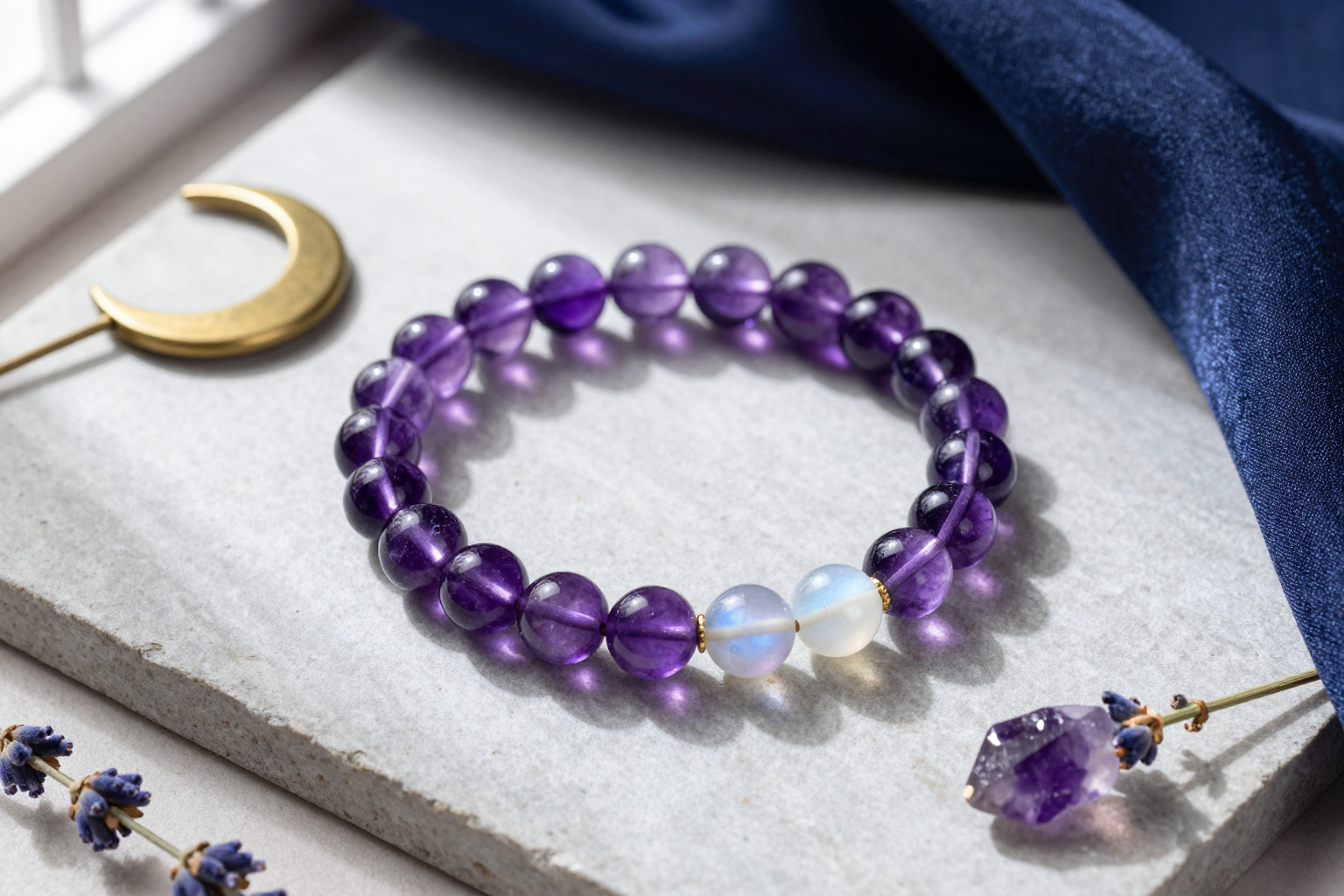
A single bracelet alternating amethyst and moonstone beads is the most balanced expression of the pairing. It keeps the stones in constant contact and reads as one intentional piece, which suits anyone who wears a watch on the other wrist. Alternate equal 8mm beads, or pair a 10mm amethyst with 8mm moonstone to let the darker stone lead.
Two strands on the same wrist
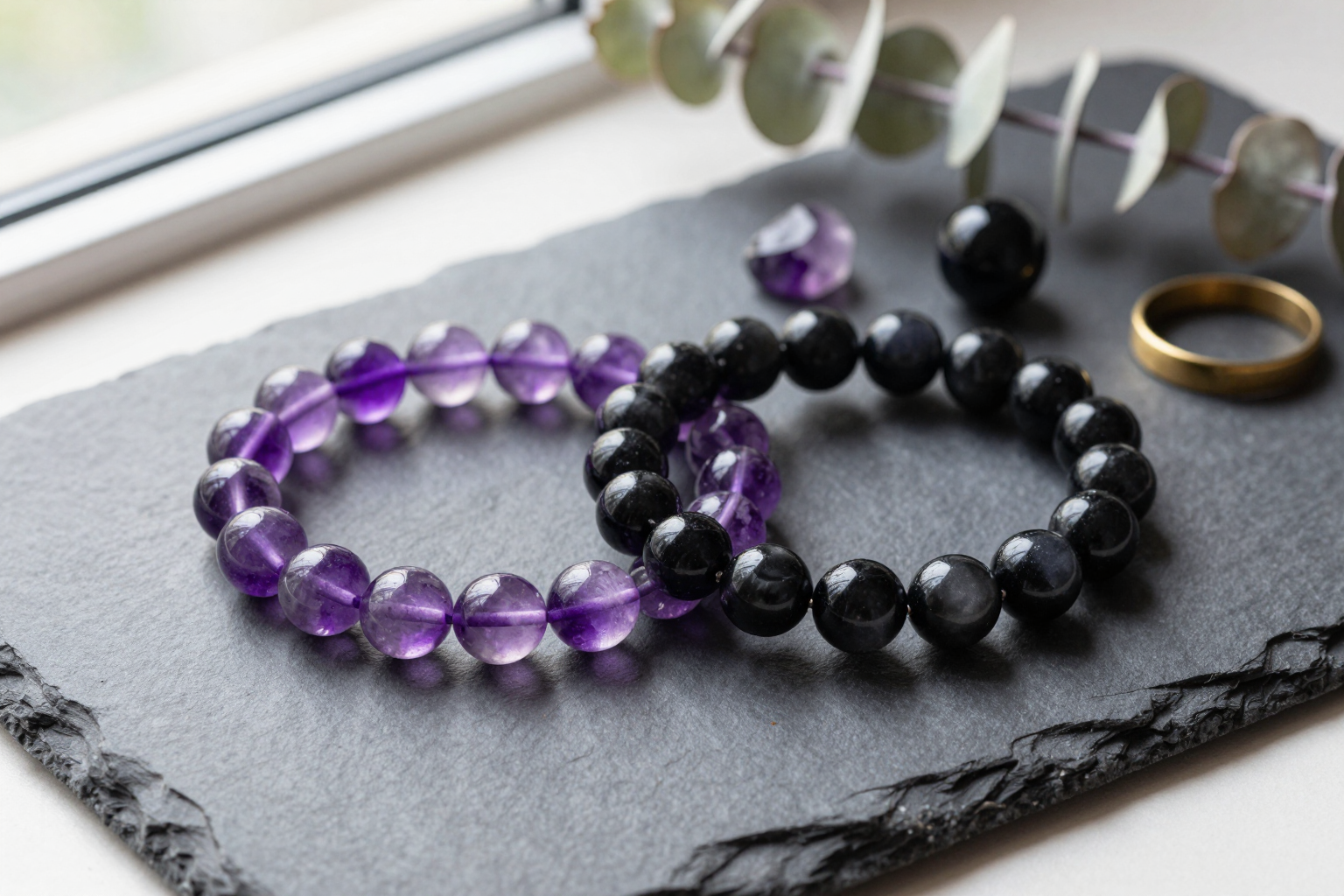
This is the version most people picture: a deep purple strand stacked with a milky white one. It is flexible — remove one on a warm night, swap the order, add a third stone later. Keep both in the same bead size, or step down by 2mm so the stack tapers. Our guide to stacking crystal bracelets covers the proportion rules.
One on each wrist
Amethyst on one wrist, moonstone on the other is the most literal reading of the pairing, and some wearers find it clearer because each stone has its own side. It also avoids the tangle of two bracelets on one arm. The trade-off: the stones no longer touch.
Which Wrist, and When to Put Them On
The traditional rule — left for receiving, right for releasing — puts both stones on the left wrist, because both are worn to take something in. If you wear a watch on the left, move the bracelets to the right; consistency matters more than the rule. Our article on left versus right wrist has the full reasoning.
Timing is where this pairing differs from most. Treat it as an evening piece: on after work or your evening shower, through the night, off in the morning if you want daytime hours for more active stones. That boundary turns a bracelet into a ritual — fastening it signals that the day is closing.
Who Gets the Most From This Pairing
Light sleepers with a busy mind
If your body is tired but your head is still running meetings, try this pairing first: amethyst addresses the mental loop, moonstone gives the body something to do other than stay braced.
Shift workers and frequent travellers
Shift workers and frequent travellers benefit most from a fixed physical cue, because the cue travels with them. A bracelet is easier to pack than a diffuser or white-noise machine.
Anyone keeping a dream journal
Both stones are traditionally linked to dream recall and vivid dreaming, which is why the pairing is popular among morning journalers. Wear it to bed for two or three weeks and note what changes.
Highly sensitive people
Moonstone’s gentle emotional buffer pairs well with amethyst’s inward focus — a common choice for people who absorb the mood of a room.
Choosing Quality: What to Look For
- Amethyst: look for even colour with translucency rather than opaque, milky purple. Fine banding is normal; a perfectly uniform glassy purple at a very low price is usually dyed quartz or glass.
- Moonstone: the sheen should move as you tilt the strand. A bead that looks flat white from every angle may be imitation. Small internal fractures are normal; a painted highlight is not.
- Both: check that beads are drilled cleanly and the elastic is doubled and knotted inside a bead, not glued at the surface. Our sizing guide explains how to measure for a correct fit.
Adding a Third Stone
The pairing takes a third strand without becoming noisy, as long as the new stone belongs to the same cool, quiet family.
- Rose quartz — a soft heart-centred note, if the wind-down is about self-compassion rather than overthinking.
- Clear quartz — an amplifier that keeps the palette bright; the safest neutral addition.
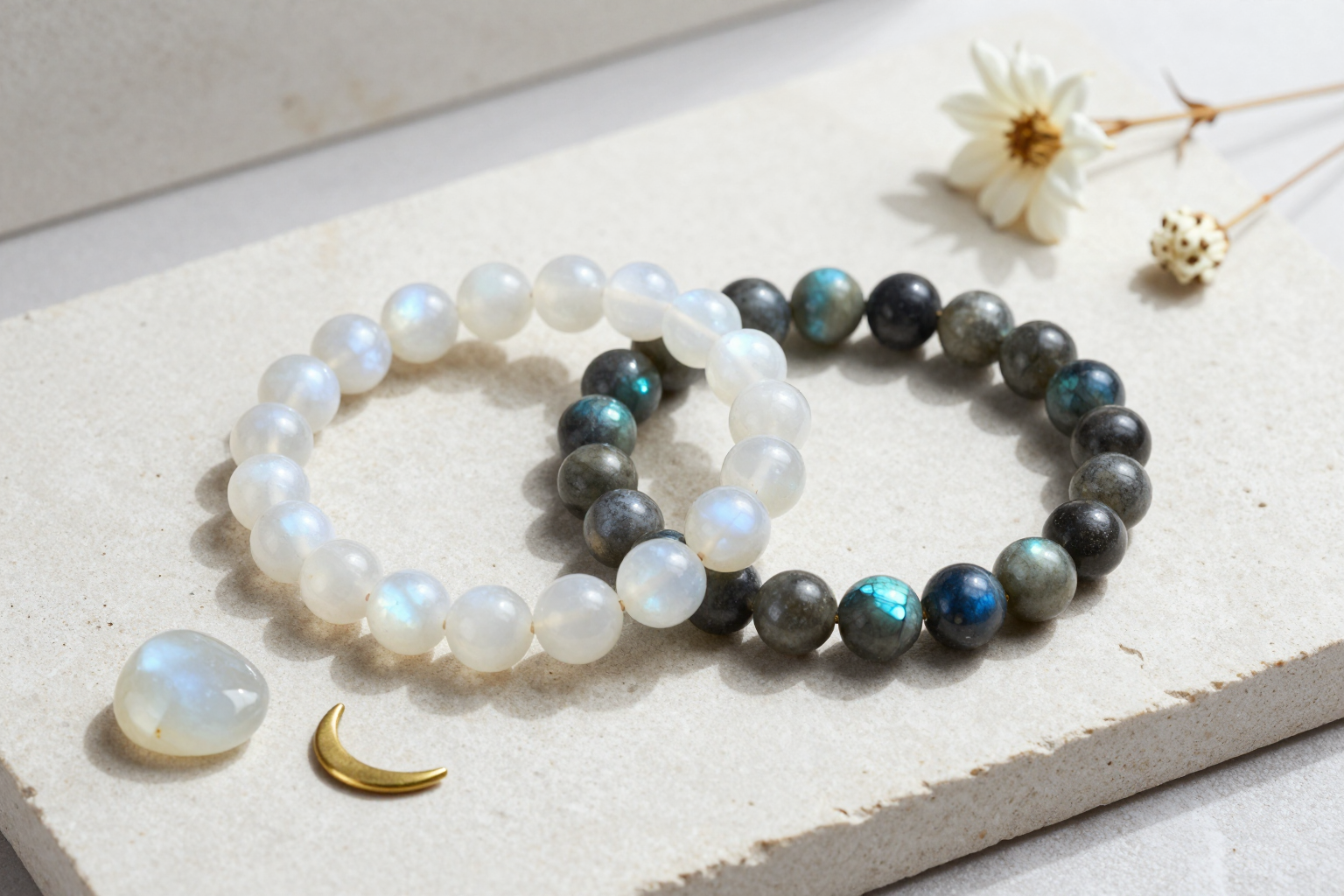
- Labradorite — a stronger filter for people who pick up others’ moods; our moonstone and labradorite pairing covers that combination separately.
- Smoky quartz — grounding and slightly heavier, useful if amethyst alone feels too “heady”.
If you are also drawn to obsidian, read our note on amethyst and obsidian together first — obsidian is a far more opposing energy.
Zodiac and Five-Element Fit
Amethyst is the traditional birthstone for February and a classical stone for Pisces, Sagittarius and Aquarius; moonstone is the June birthstone, most often assigned to Cancer and Pisces — a natural water-sign pairing. Browse the collections: Pisces, Cancer, Aquarius and Sagittarius.
If you follow Chinese astrology, the pairing works as a general water-element stack alongside a triple harmony bracelet, provided the third strand stays in a compatible element.
Care: The Two Things That Ruin These Stones
Sunlight. Amethyst’s colour is not fully stable — prolonged direct sun fades the purple toward grey over months. Store it in a pouch and cleanse it with moonlight or a selenite plate rather than sunbathing it.
Harsh cleaning. Moonstone is Mohs 6–6.5 with visible cleavage, so ultrasonic cleaners, steam, salt soaks and household chemicals can cloud it or open fractures. Wipe with a soft damp cloth, dry immediately, and store it away from harder jewellery. Details are in our crystal bracelet care guide.
Five Mistakes to Avoid
- Wearing the pair 24/7. If it never comes off, it stops being a bedtime cue.
- Mixing bead sizes carelessly. A 6mm moonstone beside a 12mm amethyst looks accidental; step by 2mm at most.
- Buying dyed “moonstone”. Real moonstone is never neon blue; the sheen is a floating highlight, not a colour.
- Cleansing moonstone in salt water. Salt is abrasive and dulls a soft feldspar.
- Expecting stones to fix a bad sleep environment. No bracelet outworks a lit room, a late coffee or a phone at midnight.
Frequently Asked Questions
Can you wear amethyst and moonstone on the same bracelet?
Yes, and it is the most common way to wear the pairing. Alternate the stones evenly, or repeat a pattern such as two amethyst to one moonstone. Keep both in the same bead size, and use a doubled elastic so the strand holds its shape.
Which stone goes closest to the hand?
There is no fixed rule. Some put moonstone nearest the hand because it is softer and sits over the pulse; others put amethyst first as the “lead” stone. Choose by comfort.
Should you sleep in a crystal bracelet?
Many people do, and this pairing is designed for it. Two cautions: a snug elastic can restrict circulation overnight, so check the fit before bed, and if you move a lot in your sleep, remove it to protect the cord.
How long before you notice anything?
Give it two to three weeks of consistent evening wear. Crystal practice is subtle and individual; the reliable effect for most people is the ritual itself — a repeated cue that the day is ending.
Can men wear amethyst and moonstone?
Yes. The pairing has no gender. If 8mm beads feel delicate, choose 10mm with a matte finish, which reads more architectural and less decorative.
Do the stones need to touch?
Not strictly. Separate wrists or two stacked strands work for most people. If contact matters to your practice, a single mixed strand is the simplest guarantee.
Choose Your Pairing
Amethyst and moonstone work because they solve two halves of one problem: the mind that will not stop, and the body that will not let go. Start with one strand of each, wear them from early evening, and let the ritual settle. Browse the full range of crystal bead bracelets, explore our crystal knowledge library, or start with our guide to amethyst.

 Please wait…
