
No products in the cart.: $0.00

Crystal Bracelet Colors for Your Skin Tone: Find Your Best Match
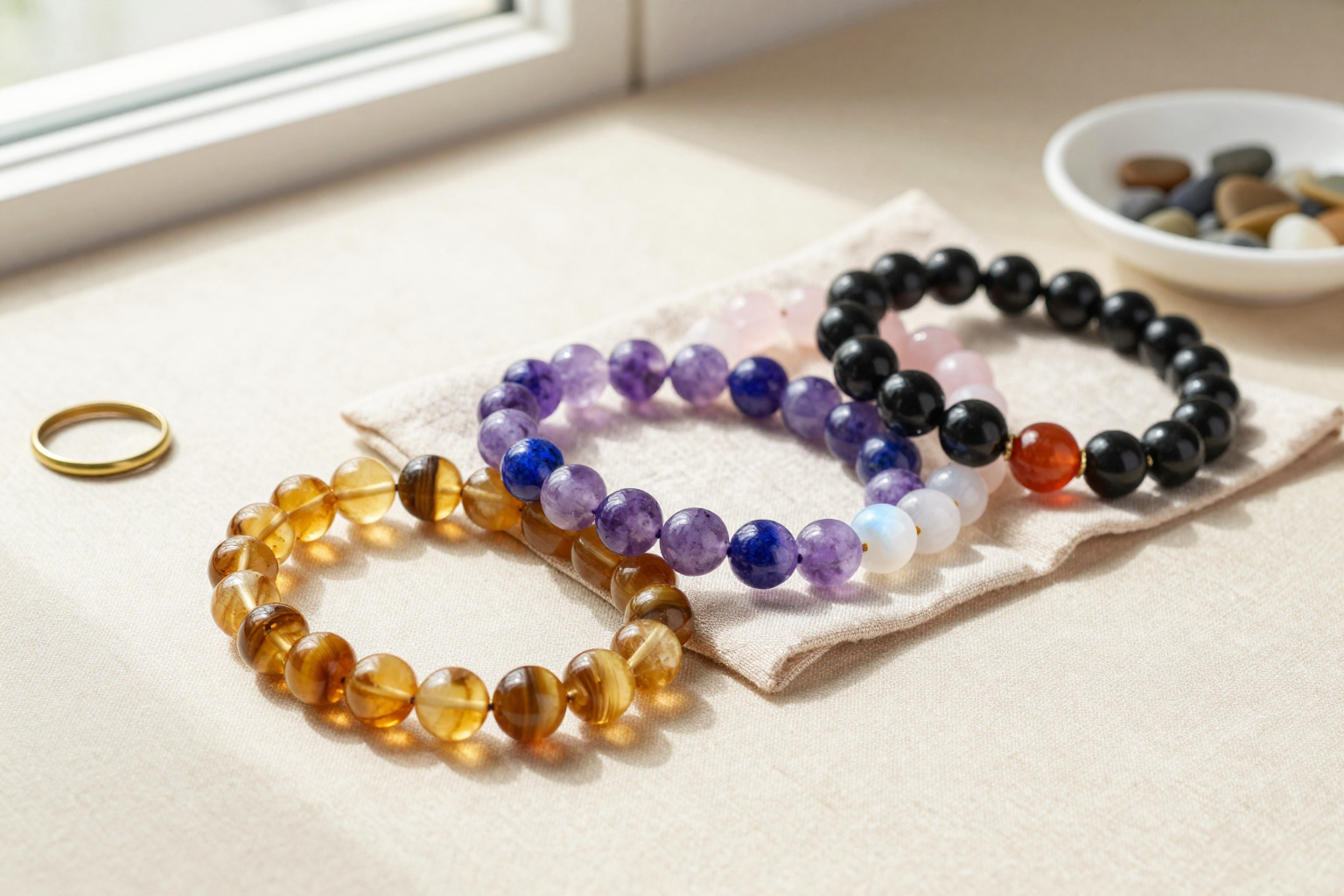
Which Crystal Bracelet Colors Suit Your Skin Tone?
The most flattering crystal bracelet colors follow your undertone, not your surface skin color: golden stones like citrine and tiger’s eye light up warm undertones, cool blues and purples like lapis lazuli and amethyst flatter cool undertones, and neutral wearers can pull off nearly everything. Identify your undertone first, then pick the color family.
Below: three sixty-second self-tests, a color-by-undertone chart, and practical notes on contrast and bead size. If you already know which meaning you want, start instead with our guide to what each crystal bracelet color means, then come back here to match it to your skin.
Quick Answer: Best Colors by Undertone
| Your Undertone | Most Flattering Stones | Handle With Care |
|---|---|---|
| Warm (golden, peachy) | Citrine, tiger’s eye, carnelian, garnet, amber, yellow jasper | Icy pale blues and pure stark white |
| Cool (pink, rosy-beige) | Amethyst, lapis lazuli, blue lace agate, moonstone, labradorite | Muddy olive greens and orange-heavy stones |
| Neutral (balanced) | Rose quartz, clear quartz, smoky quartz, green aventurine — almost everything | Only extremes: neon-bright or gray-flat beads |
| Deep skin tones | Obsidian, saturated garnet, bright carnelian, white howlite, lapis | Very pale pastels worn alone in tiny beads |
Surface Tone vs. Undertone: What Actually Matters
Your surface tone is the color you see — fair, tan, deep, olive. Your undertone is the temperature underneath it: warm (yellow, golden, peach), cool (pink, red, blue) or neutral (a balance of both). Undertone stays constant. You can tan in summer, but a warm undertone stays warm, which is why it is the reliable basis for choosing jewelry colors.
Two people with identical deep skin can have opposite undertones, and the same bracelet can look striking on one and dull on the other. This is why “colors for dark skin” lists are less useful than they sound: depth changes contrast, which we cover later, but temperature decides which hues harmonize. The good news: undertone is easy to identify at home.
Three 60-Second Tests to Find Your Undertone
The vein test
Look at the veins on the inside of your wrist in natural daylight. Greenish veins usually signal a warm undertone; blue or purple veins signal cool; a mix of both, or veins you cannot clearly classify, points to neutral. Do it near a window, not under warm indoor bulbs, which tint everything yellow and skew the result toward “warm.”
The jewelry test
Hold a gold-toned bangle against your inner wrist, then a silver one. If gold makes your skin look brighter and more even, you are likely warm. If silver looks cleaner and gold looks brassy, you are likely cool. If both look fine, you are neutral — and honestly the luckiest category for crystal shopping, because nearly every color family will sit well on your wrist.
The white paper test
Hold a plain white sheet of paper next to your face in daylight. If your skin reads yellowish or golden against it, you lean warm; if it reads pinkish or slightly blue, you lean cool. Many people find this the clearest test, because pure white gives the eye an honest reference point.
If the tests disagree, trust the jewelry test — real-world reactions to metal are hard to fool — or assume neutral and enjoy the widest color range.
Best Crystal Bracelet Colors for Warm Undertones
Warm undertones are lit from within by golden, honeyed and fiery stones. Citrine is the textbook choice: its translucent yellow echoes golden skin and brightens the whole arm. Tiger’s eye works the same register in a chatoyant golden-brown, and reads wonderfully against tanned or olive-warm skin. Carnelian and garnet add saturated warmth for evenings; yellow jasper keeps it muted and matte for daytime.
Approach icy shades carefully. Pale frosty blues and stark snow-white beads can pull slightly gray against very warm skin — not always, but enough that we suggest trying them on first. Warm wearers who love blue usually do better with rich royal or teal-leaning blues than with pastel ice. Browse the Fire element collection for the warm palette in one place.
Best Crystal Bracelet Colors for Cool Undertones
Cool undertones come alive next to blues, violets and clean whites. Amethyst is the natural first bracelet: violet flatters pink-based skin almost universally, and it is one of the most affordable quality stones. Lapis lazuli gives a deeper, inky blue that looks sharply tailored on cool skin, while blue lace agate and aquamarine offer the gentler end of the family. Moonstone, with its blue-white sheen, is the cool-tone neutral that goes with everything in your wardrobe.
The risky zone for cool undertones is orange-heavy warmth: strong amber, orange carnelian and very yellow citrine can emphasize redness in the skin. If you are cool but love warm stones, choose ones with brown or red depth — garnet rather than orange, smoky quartz rather than honey yellow. The Water element collection gathers the cooling families.
Best Crystal Bracelet Colors for Neutral Undertones
Neutral undertones — roughly the foundation shade that suits both gold and silver jewelry — can wear nearly every color family well. The easiest anchors are mid-saturation stones that are neither icy nor fiery: rose quartz, clear quartz, smoky quartz and green aventurine. From there, choose by intention rather than by flattery, since almost nothing will clash. If you want a single dependable strand for daily wear, rose quartz or clear quartz is the equivalent of a white shirt: unobtrusive, endlessly combinable, always appropriate.
Best Crystal Bracelet Colors for Deep Skin Tones
Deep skin gives you the widest contrast range in jewelry, and contrast is where deep tones shine. Glossy black obsidian looks sculptural and intentional; saturated garnet, bright carnelian and royal lapis pop vividly; crisp white howlite or clear quartz creates a clean graphic edge. Labradorite is a quiet luxury pick — subtle until the blue flash appears.
The one combination to handle with care is very pale pastel beads worn alone in small sizes: against deep skin they can register as faint rather than delicate. If you love pastels, wear them in larger beads, stack them for presence, or pair them with one high-contrast strand. Stack two or three strands using the rules in our crystal bracelet stacking guide and the pastel question solves itself.
Match Your Contrast Level, Not Just Your Undertone
Temperature is half the equation; contrast is the other half. High-contrast coloring — deep hair against light skin, or very deep skin with bright eyes — handles bold pairings: black with white, garnet with clear quartz, lapis with moonstone. Low-contrast coloring looks most at ease in tonal stacks: tiger’s eye with smoky quartz, amethyst with moonstone. A useful rule: match the drama of the bracelet to the drama of your natural coloring, then adjust one step at a time.
Crystal-to-Undertone Swatch Table
| Crystal | Color Family | Best Undertone | Why It Works |
|---|---|---|---|
| Citrine | Golden yellow | Warm | Echoes golden skin, brightens the arm |
| Tiger’s eye | Golden brown | Warm | Honeyed bands flatter tan and olive-warm skin |
| Carnelian | Orange-red | Warm | Saturated heat that reads healthy, not harsh |
| Amethyst | Violet | Cool | Softens pink undertones, near-universal on cool skin |
| Lapis lazuli | Deep blue | Cool | Inky depth looks tailored against rosy-beige skin |
| Moonstone | Blue-white | Cool | Cool-neutral sheen that pairs with any outfit |
| Labradorite | Grey-blue flash | Cool, deep | Subtle until the light catches it |
| Rose quartz | Soft pink | Neutral | Mid-saturation, neither icy nor fiery |
| Clear quartz | Clear/white | Neutral, deep | Crisp graphic edge, amplifies other strands |
| Obsidian | Glossy black | Deep, warm | Sculptural contrast with real presence |
| Smoky quartz | Brown-grey | Neutral, warm | Tonal and understated, easy daily wear |
| Green aventurine | Mid green | Neutral, warm | Fresh without clashing with any temperature |
Three Mistakes People Make When Matching Color to Skin
- Judging color under shop lighting. Warm showroom bulbs flatter yellow stones and sabotage blues. Check any bracelet in daylight before deciding.
- Confusing depth with undertone. “Dark skin needs bright colors” is a starting point, not a rule. Deep skin with cool undertones still looks best in blues and violets; depth only changes how much contrast you can carry.
- Buying the color and forgetting the fit. A perfectly matched strand in the wrong size slides or strains, and no color can save that. Measure first with our crystal bracelet sizing guide, and choose a wrist with our left vs. right wrist guide.
Frequently Asked Questions
Does skin tone matter for crystal bracelets, or is it only about meaning?
Both matter, at different stages. Meaning decides which stones support your goals; undertone and contrast decide which of those stones look best on you. If two stones carry the same meaning, let your skin break the tie.
What colors look good on every skin tone?
Mid-saturation stones — rose quartz, green aventurine, smoky quartz, clear quartz — flatter virtually everyone. If you want one universal gift color, rose quartz is the safest bet; our triple harmony bracelet guide covers more gift-first options tied to Chinese zodiac groups.
Can I wear a color that “clashes” with my skin if I love its meaning?
Yes. Layer it with a flattering neutral strand to soften the transition, or choose a related stone in a friendlier shade — smoky quartz instead of honey citrine, for example. Meaning survives the swap; compatibility usually improves.
Do bead size and finish change how color looks on skin?
Noticeably. Larger beads carry more color presence, so pale shades read stronger in 10 mm than in 6 mm. Polished beads brighten their color; matte beads mute it. Deep skin tones and high-contrast coloring can carry large glossy beads beautifully.
Should I match my bracelet to my skin tone or my wardrobe?
Undertone is the better anchor, because skin is constant and wardrobes change. A bracelet that harmonizes with your skin works across your clothes; one matched to a single outfit quietly becomes unwearable after the season turns.
How can I tell if a colored “crystal” bracelet is genuine before buying?
Run the simple at-home checks in our guide on how to tell if a crystal bracelet is real — uniform perfect color, glassy bubbles and room-temperature beads are the classic red flags.
Find Your Undertone, Then Find Your Stone
Pick one test today — the jewelry test takes less than a minute — and note whether gold or silver wins. Then choose your color family from the swatch table and shortlist two or three stones that also match the change you want the bracelet to support. When you are ready to browse, the zodiac bracelet collection and five-element collections make it easy to shop by meaning with a palette you now know will suit you.

 Please wait…
